How to Measure Hockey Stick Length – Is Your Stick the Right Length?
Last updated: 25 November 2026
Looking for the right size for your height or age?
You'll find the full chart by height, weight and age in our hockey stick size chart, and for kids in the size guide for kids & juniors. This article is about something else: how to measure your stick length correctly and check whether it fits you.
How to measure the length of your hockey stick
Stand the stick straight against a wall and measure from the floor to the top end of the shaft (see picture and video).

The quick check: does the length fit you?
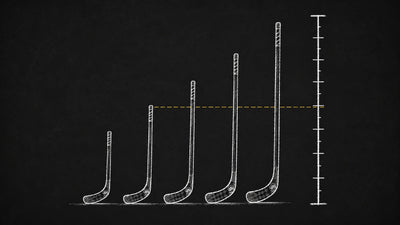
Stand up straight and look ahead. With the stick held vertically in front of you and the toe of the blade on the floor, the top end should sit between your chin and nose without skates. On skates it reaches roughly to your chin.
Correct length (without skates):

Stick too long:

How you notice on the ice that the length is off
- The blade doesn't sit flat: with a stick that is too long, the toe of the blade lifts off the ice; with one that is too short, the heel does. Passes then bounce over the blade more easily.
- Uneven wear: if the blade wears much faster at the heel or at the toe, the length or the lie doesn't fit. In inline hockey you see this pattern especially quickly.
- Puck too far away or too close: a stick that is too long pushes the puck away from your body and makes tight stickhandling harder. One that is too short forces you into a hunched stance.
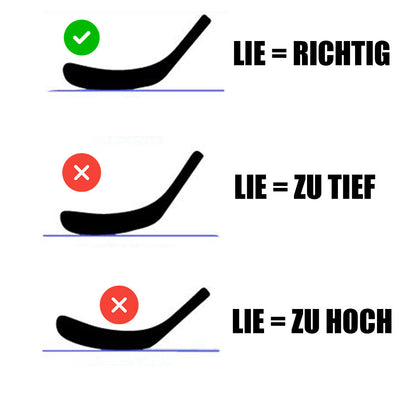
If the blade doesn't sit flat even though the length is right, the lie is often the reason. More in the lie article.
Shorter or longer: what suits which playing style
- Shorter: players who handle the puck a lot like to pull it close to the body. A slightly shorter stick makes these moves easier.
- Medium: if you work the corners, dig out pucks and stand in front of the net, an average length works best.
- Longer: defenders often play the longest sticks on the team: more reach for stick checks and intercepted passes.
These are rules of thumb, not laws. There are defenders with short sticks and skilled forwards with long ones. In the end, what counts is whether the stick feels right in your hands.
The most common stick length mistakes
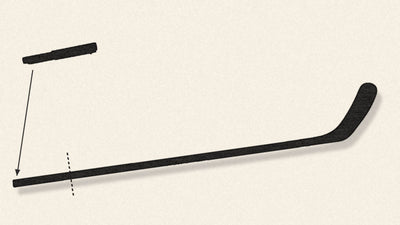
- Leaving it too long so the kid can grow into it. Better: cut it to the right length. A stick that is too long hurts posture and stickhandling. Note: an extension does not fit SOYUZ junior shafts.
- Handing a cut-down pro stick to a child. The shaft is then far too stiff and the child can't flex it. Better to buy a stick in the right size and flex.
- Cutting without thinking about flex. Every centimetre you cut makes the stick stiffer. Work out how much in Cut or extend (with flex calculator).
- Going longer just for the slapshot. In practice the shot may feel stronger, but in games you lose puck control.


 SOYUZ STD PRO SR
 Carbon Stick Extension
 Ice hockey stick INT 375g