P91A Drury Curve
The P91A / Drury Curve – The Ultimate Heel Curve for Slapshots, Saucer Passes & Net-Front Plays
Before we dive in: the Drury curve goes by different names depending on the brand.
Here’s the overview:
SOYUZ: P21 (right-hand only)
Bauer: P91A
Warrior: W05
Sherwood: PP05
CCM: P15 / P20
Formerly Easton: E6 / P6
This way, you know exactly which pattern corresponds to the Drury curve – no matter which brand you’re used to.
Important when ordering: At SOYUZ this curve is called P21. It is practically identical to the classic Drury – but available in right-hand only. See the P21 in the 3D Curve Lab.

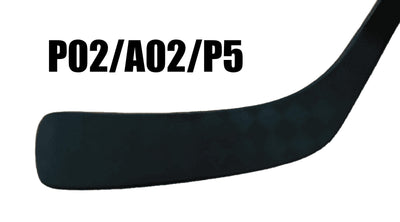
The P91A (Drury) is the ultimate classic among heel curves. A massive, straight heel-wedge design (inspired by a golf wedge) that delivers booming one-timers, silky smooth saucer passes, and deadly roof-shots around the crease.

Big names like Shea Weber and John Tavares used nothing else for years. Before the NHL increased the allowed curve depth from ½" to ¾", the Drury was the biggest (legal) curve pros could get — and for a long time, it was the most-played pattern in the entire NHL.
Even though it has become rarer today, the Drury remains a true classic. It offers tremendous control and power, especially for players who like to work heavily off the heel of the blade.
Technical Details
-
Available in Senior and Intermediate
-
Left-handed or right-handed
-
Heel wedge; deep and very open curve
-
Straight mid-section, long blade profile
-
Round toe
-
Square heel rocker
-
Very aggressive loft
-
Long and highly forgiving
Note: the specs above describe the Drury pattern in general. The SOYUZ version, the P21, comes in right-hand only.
A Weapon in Front of the Net
The open wedge design makes the P91A ideal for players who operate around the crease:
-
Perfect for deflecting shots
-
The long blade gives reliable control on tips
-
The high loft allows you to easily chip rebounds top shelf
If you love crashing the net, screening the goalie, or finishing in tight, the Drury gives you a toolbox few other curves can match.
A Defender’s Best Friend
Defensemen benefit massively from the P91A:
Defensive Zone / Breakouts
The large loft helps you:
-
Clear the puck high off the glass
-
Gently lob it into the neutral zone
-
Defuse dangerous situations with ease
The straight mid-section and long blade are ideal for:
-
Forehand and backhand passing
-
Clean, long breakout passes
-
Easy saucer passes over opposing sticks
Offensive Blue Line
At the blue line, the P91A shows its true strength:
-
Huge sweet spot for slapshots and one-timers
-
High loft helps you elevate the puck with ease
-
Perfect for defensemen who shoot often or hard from distance
It’s no surprise that Shea Weber, one of the hardest shooters in NHL history, relied on the Drury pattern.
Pros
-
Effortless saucer passes thanks to heel wedge + long blade
-
Massive sweet spot – perfect for slapshots and snapshots
-
Very forgiving for receiving passes and stickhandling
-
Easier backhand passing and shooting thanks to the straight mid-section
-
Ideal for net-front battles and deflections
Cons
-
The large loft requires good wrist roll to keep shots low
-
Long blade can feel bulky in tight board battles
-
Square heel rocker makes extremely quick-release shots harder
-
No toe hook → toe-drags & toe-shots less dominant
-
At SOYUZ available in right-hand only – left-handed players should look at the P32 first, then the P90 as a custom blade, and failing that the P02 / Lidstroem. You’ll find all three in the 3D Curve Lab
Conclusion
The P91A / Drury curve is a timeless classic and the perfect choice for:
-
Defensemen with a heavy shot
-
Players who work around the crease
-
Anyone who loves long, stable passes and easy saucers
-
Shooters who like to go “top shelf”
If you want maximum power and control from the heel of the blade, there is no way around the P91A – at SOYUZ you get it as the P21 in right-hand.
Last updated: 15 September 2026
Related Curves & Configuration
This article is part of our big Hockey Curve Guide. Also relevant: the P88 / Kane and the P02 / Lidstroem.
Further guides: P92 / P29 – the most versatile curve · P28 – the toe curve in detail
All SOYUZ models in the configurator: ARCANE · RAPID · HIT GRIT · MASTER FRST · CLASSIC SPR · AURORA · STD PRO



 SOYUZ HIT GRIT
 SOYUZ AURORA
 SOYUZ ARCANE