P29 + 1/4, P92M & P28M Explained: Are There Really Differences in Blade Height?
Why “+1/4” in Blade Height Is Mostly Marketing from Our Perspective
Many players are familiar with this situation:
You want to play the same blade as another manufacturer – and suddenly it no longer carries a familiar name like P92 or P28, but instead is called P92M, P29 + 1/4, or P92M.
Looking for a direct comparison? In our big blade guide we compare P92 vs P92M – what the max blades actually change – with our own measurements and an interactive curve-compare tool. You'll also find P92 vs P28 and every other matchup in one place.
This can quickly feel complicated and raise questions.
That’s why at ABSHockey we took a closer look at various common blade patterns and compared them. Our conclusion is surprisingly simple.
What does “+1/4” actually mean?
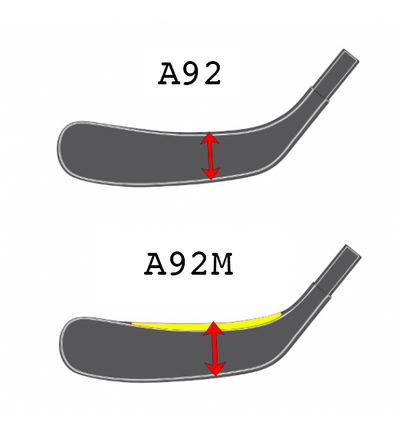
Some manufacturers use the “+1/4” addition to indicate that this blade supposedly differs by a quarter inch from a standard version – often implying a higher blade.
Many players interpret it like this:
"This blade is higher, so it plays differently."
However, based on our own comparisons, this impression cannot be clearly confirmed.
Our Measurements & Comparisons
At ABSHockey, we physically measured several common blade models and compared them side by side. Among others, we looked at the following variants:
- P28M (ABSHockey)
- P28M (Bauer)
- P28 + 1/4 (CCM)
Results from our measurements (example values):
- Blade height at the front: approx. 77 mm
- Blade height at the heel: approx. 71 mm


These values for the mentioned models were within the same measurement ranges. In our tests, we could not identify any relevant height difference attributable to the “+1/4” label.
Our Conclusion from the Comparisons
Based on our measurements and practical tests, this is what we found:
- Variants labeled “+1/4” are on the same level as comparable M variants from other manufacturers
- We found no measurable difference in blade height
- The playing characteristics felt comparable
From our perspective, this means:
- P29 + 1/4 (CCM) ≈ P92M (Bauer) ≈ P92M (ABSHockey)
- P28 + 1/4 (CCM) ≈ P28M (Bauer) ≈ P28M (ABSHockey)
(referring to the blade’s shape and height according to our measurements)
Why is this relevant for you as a player?
Many players switch manufacturers over time and ask themselves:
- “Is this blade really higher now?”
- “Does a P29 + 1/4 play differently than my previous P92?”
Based on our experience, you can relax here:
✔ Switching between these designations feels very similar in practice
✔ Differences are mostly in marketing and naming
✔ We did not identify any clear gameplay advantage from “+1/4”
If you have been playing a P92 or P28, you can usually switch directly to the P92M or P28M at ABSHockey without fundamentally changing your feel for the game.
Why do manufacturers still use such designations?
Our assessment:
- To clearly differentiate products in their range
- To create a technically sounding upgrade
- As part of brand and product communication
Such additions can make sense for internal product structuring – but they don’t necessarily indicate a real change.
Our Approach at ABSHockey
We strive to name blades as transparently and clearly as possible.
Our goal is for players to know what they are getting without having to navigate through different marketing terms.
Conclusion
Based on our measurements and comparisons:
- The “+1/4” label does not reliably indicate a higher blade
- In practice, the blade patterns mentioned are very close to each other
- Differences are more in naming than in measurable results
If you are looking for your familiar curve, you will find the corresponding variants at ABSHockey without unnecessary additional labels – clear, comparable, and transparent.
Related Curves & Configuration
This article is part of our big Hockey Curve Guide. Also relevant: the P92M & P28M and the Top-5.



 SOYUZ HIT GRIT
 SOYUZ AURORA
 SOYUZ AURORA INT