Hockey Stick Buyer's Guide (All Brands Compared)
Hockey Stick Buyer's Guide (everything you need to know to choose the right hockey stick)
In this post I explain the differences and similarities of hockey sticks from various brands. I cover how they are alike and how they differ. I also explain things like kick points, curves and more – especially for beginners or for those looking for a stick that comes closest to their current model. I won't judge brands, as I'm biased. You decide what suits you better or worse.
KICK POINT
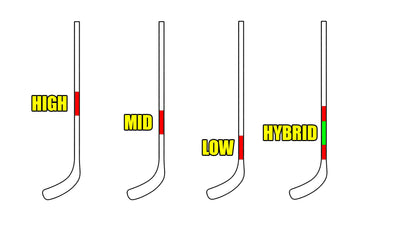
Let's start with the kick points. A stick's kick point indicates where it flexes the most. The higher it is in the shaft, the more powerful the shots. The lower it is, the faster the release.
The most common kick points are Low and Mid. But there are also Hybrid (Mid-Low) and High-Kick-Point sticks.
Popular Low-Kick-Point models:
- Bauer Vapor (current flagship: Flylite)
- CCM Ribcor (current flagship: Trigger 10 Pro)
- Warrior Covert (current flagship: QR6 Pro)
- True HZRDUS, AX and Project X
- Sherwood Rekker
- ABSHockey Custom low-kick
Popular Hybrid-Kick-Point models (Mid-Low):
- Bauer Nexus (current flagship: Tracer)
- CCM JetSpeed (current flagship: FT8 Pro)
- Warrior Alpha
- Sherwood Code
- STX Surgeon
- ABSHockey Custom mid-kick
Popular Mid-Kick-Point models (Mid-High):
- CCM Tacks and Super Tacks
- True Catalyst and XC
- Sherwood Project
- STX Stallion
- Bauer Supreme
- ABSHockey Custom High-Kick
SHAFT SHAPES
Nowadays there are various shaft shapes, closely linked to the taper designs – we'll cover that in the next section.
-
Standard shaft: The classic square shaft, proven and in use for a long time.
-
Round-square shaft: This shaft has been used for years on the Bauer Vapor models.
-
Double Concave: Made famous by the CCM RibCor models, it offers a special handling feel.
-
5-sided shaft: Introduced by Bauer with the Nexus Geo models, for even more stability and control.
-
6-sided shaft: A newer shape, e.g. on CCM Vizion, for optimal ergonomics and grip.
ABSHockey offers the standard, rounded-corner and 5-sided shaft.
There are many more variants, but these are the best-known and most commonly used shaft designs on the market.
TAPERS
On many sticks it says "Taper" somewhere. This refers to the narrowing of the shaft, which is linked to the kick point. Low-Kick-Point sticks often have more aggressive tapers than Mid-Kick sticks. Lower-end models often have no taper at all.
Some well-known taper designs:
- Vapor: XE Taper, TWITCH Taper Technology
- Ribcor: Asymmetric Taper
- Covert: Edge Taper
- Alpha: Sabre Taper II
- Nexus: ER Spine Taper
- Supreme: Sonic Taper
BLADE CURVES
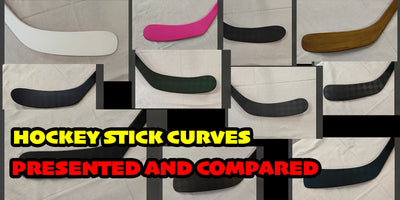
There are countless blade curves. Some are better suited for quick wrist shots, others for backhands or generally for an all-round game.
Popular curves:
- P92: Very versatile, good for everything. Recommended for beginners. (ABSHockey P92 / Bauer P92 / CCM P29 / Warrior W03 / True TC2 / Sherwood PP92)
- P28: Ideal for high shots, stickhandling. (ABSHockey P28 / Bauer P28 / CCM P28 / Warrior W28 / True TC4)
- P90TM: A mix of P92 and P28. (ABSHockey P90TM / True calls it TC6)
- P88: Good for flat shots and stickhandling. (ABSHockey P88 / Bauer P88 / CCM P88 / Warrior W88)
Curve / blade table
Similar curves are listed horizontally.
| ABSHockey / SOYUZ | CCM | Bauer | Warrior | True | Sherwood |
| P92 | P29 | P92 | W03 | TC2 | PP26 |
| P92M | P29M | P92M | M03 | PP92MX | |
| P28 | P28 | P28 | W28 | TC4 | PP28 |
| P28M | P28M | P28M | M28 | PP28MX | |
| P90TM | P90/P90TM | P90TM | |||
| P88 | P88 | W88 | MC | PP88 | |
| PM9 | P14 | PM9 | W01 | MC2 | PP96 |
| P91A | P15/P6/P38 | P91A | W05 | HCR | P20 |
| P02 | P20 | formerly P02 | W02 | HCS | PP05 |
| P14 | P49 | P14 | W14 | ||
| P08 | P77 | P08 Crazy Ovi | W11 | TC3 | |
| P77 |
FLEX
The flex indicates how much weight (in lbs) is needed to bend the stick by one inch. As a rule of thumb: the flex should be about half of your body weight. Someone weighing 150 lbs should use about 75 flex. Beginners can also go a bit softer to develop their shooting muscles.
Example: Phil Kessel weighs over 200 lbs but plays with a 65 flex!
Flex table: guide values by age, height and weight
| Age group | Height | Weight | Flex | Stick length (incl. blade) |
|---|---|---|---|---|
| Youth (4–6) | 102–124 cm | 14–28 kg | 20 / 30 | 47" (120 cm) |
| Youth (5–8) | 119–136 cm | 16–34 kg | 30 / 40 | 52–56" (132–142 cm) |
| Junior (7–11) | 124–144 cm | 36–45 kg | 45 / 50 | 57–58" (145–147.5 cm) |
| Junior (10–13) | 132–154 cm | 41–50 kg | 50 | 59–60" (150–152.5 cm) |
| Intermediate (11–14) | 142–162 cm | 50–59 kg | 50–60 | 63" (160 cm) |
| Intermediate (13–16) | 145–169 cm | 64–72 kg | 65 | 63–64" (160–162.5 cm) |
| Senior (14+) | 165–180 cm | 64–72 kg | 65–70 | 65–66" (165–167.5 cm) |
| Senior (14+) | 167–185 cm | 73–86 kg | 70–87 | 65–67" (165–170 cm) |
| Senior (14+) | 170–187 cm | 80–93 kg | 80–95 | 65–67" (165–170 cm) |
| Senior (14+) | 175–190 cm | 86–100 kg | 87–102 | 65–69" (165–175 cm) |
| Senior (14+) | 180+ cm | 95+ kg | 95–112 | 65–71" (165–180 cm) |
GRIP
Grip is a matter of taste. There is:
- Standard Grip: Very grippy, common on Bauer models.
- No grip: A completely smooth surface.
- 3D Grips: Especially on ABSHockey, Warrior and CCM models.
WEIGHT
In general: the higher the quality of the stick, the lighter it is. Here are some top models:
- Bauer Vapor Flylite: 360g
- CCM Ribcor Trigger 9 Pro: 375g
- Warrior Covert QR6 Pro: 380g
- True TRUE HZRDUS Smoke: 360g
- Sherwood Legend Pro: 390g
- ABSHockey in-stock sticks (An Lager): 350–425g
- ABSHockey Custom (SOYUZ): 365–400g depending on the model – e.g. ARCANE, AURORA & RAPID (365g), HIT GRIT, MASTER FRST & CLASSIC SPR (375g), STD PRO (400g)
LENGTH
The right stick length is important. A stick that is too long or too short can strongly affect how it plays. Cutting the shaft increases the flex, as the lever becomes shorter (see the flex table above, the length is described there too)
STICK LIE
The lie angle describes the angle of inclination of the blade relative to the shaft.
- Lie 6 is standard (P28: lie 4.5) – given as CCM lie; the SOYUZ blade is printed one number higher, e.g. lie 6 (SOYUZ 7).
- Lower lie values (e.g. 4) make the blade sit flatter on the ice.
- Higher lie values (e.g. 7) tilt the blade more.
A good test: does the entire blade rest on the ice? Then the lie value is optimal.
CONCLUSION
There is a lot to consider when buying a new hockey stick. Kick point, curve, flex, weight – everything plays a role. Ultimately, though, it comes down to personal preference. If you're unsure, start with a P92 or P90TM curve and a medium flex (about 75) – with a SOYUZ Custom stick (e.g. STD PRO, ARCANE or AURORA) you put together exactly that. And always remember: a well-chosen stick can take your game to the next level!
Why ABSHockey & SOYUZ
We build custom sticks on the SOYUZ platform. More on that: about the SOYUZ brand. On topic: the current stick comparison and the price-performance comparison.
Related detail guides: P28 – the toe curve in detail · P92 / P29 – the most versatile curve · Kick points explained · The right stick length · Lie angle explained

 SOYUZ HIT GRIT
 SOYUZ AURORA
 SOYUZ ARCANE