The 10 Best NHL Forwards of All Time
The 10 Best NHL Forwards of All Time
If you think this list is debatable, you're right — and if you think #1 is debatable, you don't know hockey.
I'm 28. Watched Gretzky live? No chance — I was three when he hung up his skates. But I've watched every available recap, never missed a single episode of Spittin' Chiclets, and could recite the career stats of these men in my sleep. This list is built on numbers, history and the respect you earn by investing thousands of hours into this game — even if it's only from the couch.
Three criteria decide everything: raw statistics, dominance in their era — and whether the game would look different without them. A guy who just scores goals is a goal scorer. A guy who changes the game is a legend. That's what this list of the best NHL forwards of all time is really about.
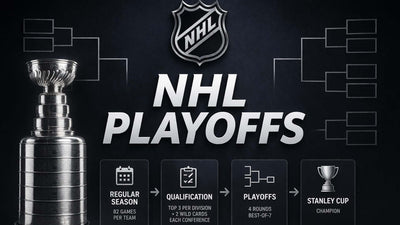
If you want to understand how the NHL Playoffs work and why these men became immortal there, check out our Stanley Cup Playoffs explained. And if you want the full picture — the Top 10 NHL Players of All Time is right here.
Steve Yzerman
When people talk about the best NHL forwards of all time, Yzerman's name comes up too late. That's not fair. Stevie Y wasn't a superstar who fell from the sky — he was a leader who earned every inch of respect. 22 seasons, one single club, three Stanley Cups. In an era where loyalty in pro sports is a rare commodity, Yzerman stands for something that barely exists anymore. I've watched hundreds of hours of Detroit footage — this man didn't lead the Red Wings, he was the Red Wings.
| Games | Goals | Assists | Points | Stanley Cups |
|---|---|---|---|---|
| 1755 | 692 | 1063 | 1755 | 3 (1997, 1998, 2002) |
Brendan Shanahan
656 goals and over 2,000 penalty minutes. I've seen that number a hundred times and it still fascinates me — because no other combination in NHL history even comes close. Shanahan was the complete forward: he could fight like an enforcer and score like a sniper. Anyone who only sees him as a goal scorer is missing half the story. He brought his teammates respect, his opponents fear — and the game a raw passion that barely exists in today's NHL.
| Games | Goals | Assists | Points | Stanley Cups |
|---|---|---|---|---|
| 1524 | 656 | 698 | 1354 | 3 (1997, 1998, 2002) |
Jaromir Jagr
Jagr was still playing at NHL level at age 45. That alone earns him a spot among the best NHL forwards of all time. I remember recaps from his final seasons — the man was still good, still dangerous. But young Jagr in Pittsburgh? Otherworldly. That backhand, the ability to hold the puck in the corner like it belonged to him personally — no winger before or after him played it like that. 766 goals, nearly three decades as a pro. Respect.
| Games | Goals | Assists | Points | Stanley Cups |
|---|---|---|---|---|
| 1733 | 766 | 1155 | 1921 | 2 (1991, 1992) |
Mike Bossy
Nine seasons. Nine times scoring at least 50 goals. Let me say that again: nine for nine. No other player in NHL history has come remotely close to repeating that. Bossy wasn't a great athlete, wasn't a fighter, wasn't a two-way player — he was a pure artist in the slot. The Islanders dynasty of the early 80s, four Cups in a row, is simply unthinkable without him. The fact that a back injury forced him out at 30 is one of the biggest what-ifs in NHL history.
| Games | Goals | Assists | Points | Stanley Cups |
|---|---|---|---|---|
| 752 | 573 | 553 | 1126 | 4 (1980–1983) |
Gordie Howe — "Mr. Hockey"
"Mr. Hockey." There's no player in sports history whose nickname needs less explanation. Gordie Howe played in the NHL while his son Marty was already a pro — on the same team. He played an NHL game at age 52. The numbers are absurd, the longevity is absurd — but what fascinates me most is the "Howe Hat Trick": a goal, an assist and a fight in the same game. The fact that this feat carries his name says everything about the man.
| Games | Goals | Assists | Points | Stanley Cups |
|---|---|---|---|---|
| 1767 | 801 | 1049 | 1850 | 4 (1950, 1952, 1954, 1955) |
Bobby Hull — "The Golden Jet"
Bobby Hull's shot was reportedly clocked at over 118 mph — no Slapshot radar, no modern technology, just the sheer panic of goaltenders. He was the first player to popularize the curved stick and changed the game forever. "The Golden Jet" was athleticism, charisma and power in a package the NHL had never seen. On top of that: he jumped to the WHA in 1972 — a radical move at the time — and proved that players could have power too. A revolutionary, on and off the ice.
| Games | Goals | Assists | Points | Stanley Cups |
|---|---|---|---|---|
| 1063 | 610 | 560 | 1170 | 1 (1961) |
Maurice "Rocket" Richard
Some players write statistics. Others write history. Maurice Richard did both. He was the first player ever to score 50 goals in 50 games — in 1944/45, in an era without modern training methods, sports nutrition or any of today's resources. But Rocket Richard was more than numbers: he was the soul of Québec, a cultural symbol for an entire nation. When the NHL suspended him in 1955, riots broke out in Montréal — the "Richard Riots." No other hockey player has ever had that kind of social impact.
| Games | Goals | Assists | Points | Stanley Cups |
|---|---|---|---|---|
| 978 | 544 | 421 | 965 | 8 (1944–1960) |
Mario Lemieux — "Le Magnifique"
Lemieux is the greatest what-if in NHL history. The man played through cancer, through back surgeries, through a hiatus of nearly two years — and still finished as the second-highest scorer of all time. If Lemieux had been healthy, we'd be debating #1 right now, not #3. His adjusted points per game actually surpass Gretzky. 1.88 points per game. For his entire career. That's not a stat, that's science fiction. 6'4", fluid as a ballet dancer, strong as a bull — "Le Magnifique" is the most complete forward I've ever seen on film.
| Games | Goals | Assists | Points | Stanley Cups |
|---|---|---|---|---|
| 915 | 690 | 1033 | 1723 | 2 (1991, 1992) |
Bobby Orr
I know what you're thinking: Bobby Orr was a defenseman. Correct. And yet he sits at #2 on this list of the best NHL forwards of all time — because Orr played the game in a way that made positions completely irrelevant. He won the scoring title twice. As a defenseman. He revolutionized his position so completely that every offensive blueliner since has only ever been described as "the next Orr" — and none has ever really come close. Eight knee surgeries robbed him of a career this list would look very different without. With two healthy knees? Maybe #1.
| Games | Goals | Assists | Points | Stanley Cups |
|---|---|---|---|---|
| 657 | 270 | 645 | 915 | 2 (1970, 1972) |
Wayne Gretzky — "The Great One"
There is no debate. I was three years old when Gretzky retired — I'll never have seen him live. But I've watched every available tape, read every analysis, listened to every podcast that's ever mentioned his name. And the more you dig in, the more incomprehensible he becomes. Wayne Gretzky scored more points than any other player in NHL history — and if you only count his assists, he'd still be leading the all-time points list. Let that sink in: his assists alone beat every other player ever. That's not a statistic anymore. That's a force of nature. He was never the fastest, never the strongest. He was simply smarter than everyone else — two seconds ahead, always, on every rink, in every situation. When we talk about the best NHL forwards of all time, the answer starts and ends with one name.
| Games | Goals | Assists | Points | Stanley Cups |
|---|---|---|---|---|
| 1487 | 894 | 1963 | 2857 | 4 (1984, 1985, 1987, 1988) |
Final Thoughts: Gretzky is untouchable — but who's really #2?
#1 is settled. It was 30 years ago, it will be in 30 years. The really interesting question is: who comes after him? Lemieux without the injuries? Orr without the blown-out knees? I could have this debate for hours — and honestly, I do.
That's the beauty of this list: it's never really finished. New generations discover these men through highlights, podcasts and statistics — just like I did. And that's exactly what makes the best NHL forwards of all time so immortal: they're legends, not statistics. They live on as long as we argue about them.
Your take? Drop it in the comments — I'm genuinely curious.
More from our NHL blog
The Stick Behind the Goals
Whether Kane, Ovechkin or modern snipers – the right pattern makes the difference. Learn more in the Curve Guide, the P88 / Kane guide and our Top-5 curves.



 SOYUZ HIT GRIT
 SOYUZ AURORA
 SOYUZ ARCANE