Hockey Stick Blade Guide 2026: Which Curve Is Right for You?
Your hockey stick blade affects everything – your passing, your shooting, your stickhandling and your shot feel. Many players underestimate this and simply buy what their favourite pro uses. That's often a mistake.
In this guide we show you which hockey stick curve fits your playing style – whether you're a beginner, a seasoned player, or a true stick nerd who knows every curve by heart.
👉 Configure your SOYUZ BC now
👉 Not sure? Write to us – we'll help you personally.
Table of Contents
- 30-Second Decision: Which Blade Is Right for You?
- Curves Compared Head-to-Head: P92 vs P28, P92 vs P29, P90TM, P92M, P86
- Heel, Mid, Toe – What Does It Mean?
- All SOYUZ BC Standard Blades Overview
- Pro Custom Blades – All Models
- Comparison with Bauer, CCM, Warrior, True, Sherwood
- The Right Lie Angle
- The Most Common Mistakes When Choosing a Blade
- Which Blade Do NHL Pros Use?
- FAQ
🎯 30-Second Decision: Which Blade Is Right for You?
No time for the full guide? Here's the short version:
| Your Playing Style | Recommended Blade | Why? |
|---|---|---|
| Beginner or unsure | P92 | Versatile, forgiving, most popular blade worldwide |
| Lots of passing, playmaker, backhand matters | P88 | Very controlled, comfortable backhand, Patrick Kane's blade |
| All-round with modern feel | P90TM | Versatile, modern feel, slightly more neutral than P92 |
| Sniper, quick release, toe drag | P28 | Aggressive toe, explosive release, Eichel/Giroux blade |
| Between P92 and P28, modern-offensive | P86 | Hybrid blade, more toe than P92 but more control than P28, Celebrini's blade |
| Defenseman, slap shots, long passes | P91DN | Mid-heel, powerful one-timers, physical play |
| Classic defenseman, old-school slapper | P05 | Heel curve, long blade, Lidström/Kronwall blade |
| More surface for faceoffs / tip-ins | P92M | P92 base with more height, Pettersson/Tkachuk blade |
Our default recommendation if you're really unsure: P92. It's the best starting point for most players and one of the most widely used blades in the world.
Curves Compared Head-to-Head
The table above tells you which blade suits which type of player. What it doesn't tell you: what actually changes when you switch from one curve to another? That's what this section is for — the five matchups people search for most, compared directly.
One note before we start: the internet is full of numbers about blades that nobody can back up — face angles in degrees, millimetre figures for blade height, percentage breakdowns of NHL players. Here we only state what manufacturers publish or what we have measured ourselves. And where no reliable source exists, we say so.
P92 / P29 vs P28
By far the most common comparison — and the one with the most confusion around it.
What the manufacturers say. Bauer lists the P92 as a mid curve with an open face and lie 6, and the P28 as a mid-toe with an open face and lie 5. Worth noting: almost every retailer shifts both one step further and calls the P92 "mid-toe" and the P28 "toe". We stick to the manufacturer's data, even if it looks unfamiliar.
| P92 (Bauer) / P29 (CCM) | P28 | |
|---|---|---|
| Curve type | Mid | Mid-Toe |
| Face | open | open |
| Lie (Bauer) | 6 | 5 |
| Blade length | Medium-Long | Medium |
| Toe | round | round |
What changes on the ice. The core difference is the point where the puck leaves the blade. On the P28 it sits further forward, towards the toe — that's where the quick, hard-to-read release comes from. On the P92 it sits closer to the middle, which makes the shot more predictable and the puck handling calmer. The price of the P28 is the same in every source: keeping the puck low gets harder, and the backhand demands clean technique because there is less flat surface to work with.
Our take from the shop floor: a good player can adapt to almost any curve — but even for a good player, P92 and P28 feel noticeably different. The P28 belongs in the hands of strong stickhandlers. Master it and you get a release no goalie can read; until your technique is there, that release is unpredictable for the shooter too. The P92 is the more consistent blade: stronger on faceoffs, better for one-timers and slap shots, more reliable on the backhand and more versatile overall. Plenty of players choose the P28 anyway — precisely for that unreadable release and the toe stickhandling. That's perfectly legitimate. Just know what you're giving up for it.
And one honest caveat: the widespread claim that the P28 is wrong for defensemen is, in our view, not supported. The retailer HockeyStickMan names Drew Doughty and Mark Giordano — both defensemen — as P28 users and praises the curve for passing. Player forums even report the opposite of the usual sales pitch: several users found toe drags harder with the P28 than with their previous blade.
P92 / P29 in detail · P28 in detail
P92 vs P29 — are they the same curve?
Short answer: almost. And the difference is not where most people think it is.
Bauer calls it P92, CCM calls it P29. Both run lie 6 with an open face, and the blade length — contrary to what some comparison charts suggest — is the same. The real difference sits in the curve itself, in the stiffness of the blade and in the foam core built inside. We make both as separate blades precisely because that difference exists. But we'll also say it plainly: for amateur players it is barely noticeable. Switching from one to the other requires no adjustment.
The equivalents at the other brands:
| Brand | Name |
|---|---|
| Bauer | P92 |
| CCM | P29 |
| Warrior | W03 |
| True | TC2 (older), now T92 |
| Sherwood | PP26 (older), now PP92 |
| SOYUZ | P92 / P29 |
Why the numbers don't line up has a mundane explanation: CCM inherited its numbering system from the Reebok takeover. Today's P29 goes back to the Reebok P87A, which was marketed as the Crosby curve.
And one side note that shows how little these names mean: the P92 was sold for years as "the Sakic curve". Joe Sakic never played it.
P90TM vs P92 and P28
This is where it gets interesting, because the usual shorthand — "sits geometrically between P92 and P28" — is only half the truth.
For the Bauer version it's literally the manufacturer's own description. Bauer says the P90TM combines the consistency of a P92 with a more aggressive toe like the P28, and lists it as mid-toe with lie 6.
For the CCM version it doesn't hold. CCM lists the P90TM with lie 5 and a long blade. And a detailed review by hockeyreviews.ca describes a structural difference that shows up in no comparison chart: the CCM version has a flat zone on the bottom instead of a continuous rocker. It doesn't roll evenly from heel to toe the way a classic curve does.
In plain terms: Bauer's P90TM and CCM's P90TM are not the same blade according to the published data — even though they share a name. Switching from one to the other means switching more than just brands.
As for what TM stands for — nobody knows. Neither Bauer nor CCM explains the abbreviation anywhere public. The only usable clue comes from pro-stock listings where "P90T" and "P90TM" appear in parallel with "P92 / P92M" and "P28 / P28M" — which would suggest "P90T plus Max". That's unconfirmed, and parts of the community explicitly disagree.
P92 vs P92M — what the max blades actually change
Bauer's only official statement on the max blades is that additional material is added to the top of the blade — to help with puck control on bad ice, in battles, when tipping pucks and on faceoffs. Curve, lie, face and toe shape stay the same; the only thing that changes is the height.
So much for the theory. Now the part where we disagree with the rest of the internet.
We measured. In our measurements, both the M versions and the regular blades sit at the NHL maximum of 76.2 millimetres (3 inches) at the toe, and at around 71 millimetres at the heel. A measurable height difference between P92M and P92 — or between the "+1/4" variants and the base blades — is not something we could find.
There are no published millimetre figures from any manufacturer on this. Neither Bauer nor CCM, Warrior or True publishes dimensions for their max blades. Anyone quoting you a specific number has either measured it themselves — or made it up.
On the rules: the NHL rulebook limits blade height to 3 inches (76.2 mm) and, separately, curve depth to ¾ inch (19 mm). Since max blades have the same curve and are simply built taller, the height rule is what matters for them, not the curve rule.
Our measurements of the max blades and the +1/4 variants
P86 vs P92, P28 and P90TM
The P86 goes back to the pro-stock curve PRO9246, associated with Trevor Zegras. The two are not identical — but very closely related. The common shorthand "a P92 shape with a toe hook" captures it well and is unusually well supported: one retailer describes the PRO9246 literally as "a P28 on a P92 blade shape", and a detailed review confirms that the blade takes over the P92's shape — including the round rocker on the bottom.
That gives us the cleanest dividing line between P86 and P90TM we've found: both are toe-leaning descendants of the P92. But the P86 keeps the P92 rocker — the P90TM (in its CCM version) does not. If you're coming from a P92 and want to keep the familiar roll point, the P86 is closer to home.
The lie matches the P92 and P29 — unlike the P28, which runs flatter.
One caveat: as far as we know, the P86 is not part of CCM's regular retail lineup. It's available through pro-stock and team channels — and from us as a standard blade.
Compare every curve yourself
Our Curve Compare tool puts two or three curves directly on top of each other — side by side, as an overlay with an opacity slider, or with a wipe control. You also get the specs and the Bauer, CCM, Warrior and True equivalents in one table. More than 80 curves are in the database.
Six claims you'll read everywhere — that nobody can back up
If you research blade curves, you'll run into these statements constantly. Not one of them has a reliable source:
| Claim | What's actually verifiable |
|---|---|
| "The P90TM is McDavid's curve." | No primary source. A specialist retailer reports McDavid plays a modified P29. |
| "The P28 is McDavid's curve." | Marketed that way by CCM. The same retailer calls it "quite different from his pro pattern". |
| "The P92 is Matthews' curve." | Marketed that way by Bauer. Reports point to a P29-style pattern. |
| "The P90TM is Tavares' curve." | Marketed that way by CCM. Reports point to a P6. |
| "The P92 is the Sakic curve." | Sakic never played it. |
| "X percent of NHL players use the P92." | No publicly verifiable statistic on curve distribution in the NHL exists. |
We're not writing this to sound clever — it matters for your buying decision: picking a curve because of a pro's name only works if the pro actually plays it. And that's less often the case than you'd think.
Heel, Mid, Toe – What Does It Mean?
Before diving into the individual blades, a quick look at the basics. The blade type describes where on the blade the curve is strongest.
Heel Curve – Curve at the back
The curve starts close to the shaft. Typical for defensemen: powerful slap shots, long precise passes, plenty of surface for stable puck reception. Examples: P05, P91DN.

Mid Curve – Curve in the middle
The curve sits in the middle of the blade. Creates a good balance between passing, shooting and control – which is why it's so popular with all-round players. Examples: P92, P88, P90TM.

Toe Curve – Curve at the front
The curve sits further forward in the toe area. Favours quick releases, toe drags and explosive offensive play – but more demanding on the backhand. Examples: P28, P28M.

All SOYUZ BC Standard Blades Overview
SOYUZ BC offers a wide range of standard blades – available from 1 stick. Here you'll find all models with description, player reference and a clear recommendation.
P92 – The Classic
Type: Mid-Toe | Lie: 6 | Known Players: Backström – also marketed as the "Matthews" and "Sakic" curve, neither of which is verified (see the myth table above)

The P92 is the most widely used blade in the world – and for good reason. It offers a balanced mix of passing, shooting and stickhandling. Neither too offensive nor too neutral. Ideal for beginners, still excellent for advanced players.
✔️ All-round players ✔️ Beginners to advanced ✔️ Centers ✔️ Wingers
Comparable to: P92 (Bauer) / P29 (CCM)
P92M – P92 with More Surface
Type: Mid-Toe | Lie: 6 | Known Players: Pettersson, Tkachuk

Same shape as the P92, but with a little more blade height. That gives more surface for tip-ins, faceoffs and deflections in front of the net. If you like the P92 feel but want more blade surface, this is your blade.
✔️ Centers with lots of net-front work ✔️ Faceoff specialists ✔️ Deflection specialists
Comparable to: P92M (Bauer) / P29M (CCM)
P88 – Control and Backhand
Type: Mid | Lie: 6 | Known Players: Patrick Kane

The P88 is the blade for playmakers and technically strong players. Very controlled, comfortable backhand, strong passing. Less explosive than the P28, but significantly more forgiving. Also an excellent choice for beginners.
✔️ Playmakers ✔️ Beginners ✔️ Backhand-oriented players ✔️ Wingers with a technical style
Comparable to: P88 (Bauer / CCM)
P90TM – Modern and Versatile
Type: Mid | Lie: 5 | Marketed under the name of: John Tavares (CCM) – whether the pros actually play the retail version is not verified

The P90TM is marketed under big player names – none of those attributions is verified (see the myth table above). None of that changes the blade itself. Very versatile, modern feel, great balance between passing and shooting. Slightly more neutral than the P92, making it especially comfortable for players who work a lot on both hands.
✔️ All-round players ✔️ Modern playing style ✔️ Centers and wingers ✔️ Players who want to combine control and release
Comparable to: P90TM (Bauer / CCM)
P28 – For Snipers and Quick-Release Players
Type: Toe | Lie: 5 | Known Players: Jack Eichel, Claude Giroux

The P28 is one of the most popular offensive blades of recent years. Aggressive toe, explosive release, perfect for toe drags and quick wrist shots. Requires clean technique though – not the first choice for beginners, as the backhand becomes more demanding.
✔️ Offensive players ✔️ Snipers ✔️ Toe-drag players ❌ Not ideal for beginners
Comparable to: P28 (Bauer / CCM)
P28M – P28 with Even More Surface
Type: Toe | Lie: 5

The more uncompromising version of the P28. More height, more surface, even more specialised. Can help with one-timers and certain finishes, but is even more demanding in terms of control. For players who know exactly what they want.
✔️ One-timer specialists ✔️ Snipers ❌ Requires good puck control
Comparable to: P28M (Bauer / CCM)
P86 – The Hybrid Between P92 and P28
Type: Mid-Toe (Hybrid) | Lie: 6–6.5 | Origin: Goes back to the pro-stock curve PRO9246 (Trevor Zegras) – very similar, not identical

The P86 fills the gap between P92 and P28. At the heel it feels like a P92 – controlled, comfortable, familiar. Towards the toe it gets more aggressive and shot-oriented. The result: a modern offensive blade that isn't as extreme as a pure toe curve. For many P92 players, the most natural next step.
✔️ Modern offensive players ✔️ Players who want more than P92 but find P28 too extreme ✔️ Toe drags ✔️ Quick releases
Comparable to: P86 (CCM) / P86 Pro Stock (Bauer)
P91DN – For Defensemen and Slap-Shot Artists
Type: Mid-Heel | Lie: 6 | Known Players: Staal

The P91DN is built for physical, powerful play. Mid-heel blade with a focus on slap shots, one-timers from the blue line and physical defensive play. Gives you lots of pressure on the shot, but less agile in tight situations.
✔️ Defensemen ✔️ Slap-shot specialists ✔️ Powerful one-timers ✔️ Physical playing style
Comparable to: Bauer Pro Stock BT-P91DN
Looking for the Drury blade (Bauer P91A)? At SOYUZ that's the P21 – available as a Pro Custom Blade, RH only.
P05 – The Classic Defender Blade
Type: Heel | Lie: 7 | Known Players: Lidström, Kronwall

Long, flat heel curve with a square toe. Lots of blade surface, stable puck reception, ideal for long passes and slap shots from the blue line. One of the most classic defender blades ever – less suitable for offensive forwards.
✔️ Classic defensemen ✔️ Slap shots ✔️ Long, precise passes ✔️ Taller players
Comparable to: formerly P02 (Bauer) / P20 (CCM)
SOYUZ Pro Custom Blades – All Models
In addition to the standard blades, SOYUZ BC offers over 30 Pro Custom Blades – available from 3 sticks. These blades are manufactured to your exact specs and cover a wide range of playing styles – from rare pro blades to very specific curves no longer available from standard brands.
⚠️ Some models are only available as LH (Left Hand) or RH (Right Hand).
👉 Interested? Write to us – we'll advise you on Pro Custom Blades.
| Technical Drawing | Model | Availability |
|---|---|---|
 |
P78-ST | LH only |
|
P92M-SBT | LH & RH |
 |
P22-ST | LH only |
 |
P29 | LH & RH |
 |
P27 | LH only |
 |
P6SR-ST | LH only |
 |
P19Y-ST | RH only |
 |
P18K | LH only |
 |
P42 | LH only |
 |
P7TK | LH & RH |
 |
P9 | LH & RH |
 |
P90M | LH & RH |
 |
P71 | LH only |
 |
P29M | LH & RH |
 |
P21 | RH only |
 |
P13 | LH & RH |
 |
P8TM-SBT | LH & RH |
 |
P32 | LH & RH |
 |
P33 | RH only |
 |
P35 | LH only |
Hockey Blade Comparison: SOYUZ BC vs. Bauer, CCM, Warrior, True, Sherwood
Already playing a specific blade from another brand and want to know which SOYUZ model matches? This table helps.
| SOYUZ BC | CCM | Bauer | Warrior | True | Sherwood |
|---|---|---|---|---|---|
| P92 | P29 | P92 | W03 | TC2 / T92 | PP26 |
| P92M | P29 +1/4 | P92M | M03 | PP92MX | |
| P28 | P28 | P28 | W28 | TC4 | PP28 |
| P28M | P28 +1/4 | P28M | M28 | PP28MX | |
| P90TM | P90 / P90TM | P90TM | W90TM | T90T | |
| P88 | P88 | W88 | MC | PP88 | |
| P91DN | BT-P91DN (Pro Stock) | ||||
| P21 | P21 | P91A | W05 | HCR | P20 |
| P05 | P20 | formerly P02 | W02 | HCS | PP05 |
| P86 | P86 | P86 (Pro Stock) |
The Right Lie Angle on a Hockey Stick
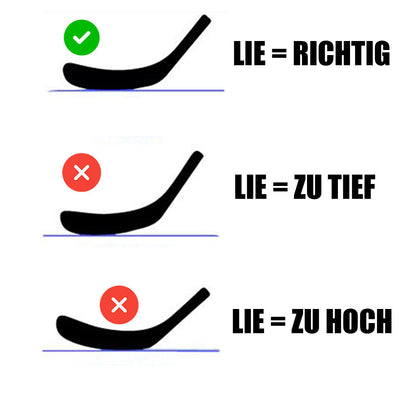
The lie angle describes the angle between the blade and the shaft. It has a big impact on whether the blade lies flat on the ice in your natural playing stance – and that's crucial for puck control and passing accuracy.
| Player Stance | Recommended Lie |
|---|---|
| Upright, stick close to body | Lie 6–7 |
| Normal playing stance | Lie 5–6 |
| Deep crouch, stick far from body | Lie 4–5 |
Simple test: Get into your normal playing stance and check whether the blade lies completely flat on the ice. Toe lifts up → lie too low. Heel lifts up → lie too high.
A note on our lie values: our standard curves run the same lie as their Bauer and CCM equivalents. Many blades are additionally available as variants in other lies – that's why the Curve Compare tool above sometimes shows different lie values. Those are the variants, not the standard blade.
The Most Common Mistakes When Choosing a Hockey Stick Blade
❌ Choosing a blade because of an NHL pro
Just because a curve carries an NHL star's name doesn't mean it suits you – often the pro doesn't even play the retail version named after him. NHL pros have completely different technique, skill level and requirements. Choose the blade for your playing style – not for the name on the data sheet.
❌ Going straight for a toe curve as a beginner
P28, P28M and similar toe blades are offensively strong, but more demanding on the backhand and in general control. Start with P92 or P88 – and switch when you know what you want.
❌ Ignoring the lie angle
Even the perfect blade performs poorly if the lie is wrong. If the blade doesn't lie flat on the ice, everything suffers – puck control, passing, shooting.
❌ Not comparing enough
Test different blades with teammates or in the locker room when possible. Often you only discover what really works on the ice.
Which Hockey Stick Blade Do the Best NHL Players Use?
This pie chart from a 2023 community survey shows which blades the top-50 NHL point scorers used at the time. The P92 clearly dominates – followed by P28 and P90TM. As far as we can tell, no more recent, methodologically sound survey of curve distribution in the NHL exists.

Source: Reddit r/hockeyplayers
Important: These numbers are interesting as a reference – but they should never be the sole reason for your choice. What matters is what suits your game.
FAQ: Frequently Asked Questions About Hockey Stick Blades and Curves
Which hockey stick blade is best for beginners?
The P92 is the best choice for most beginners. It's versatile, forgiving and the most widely used blade in the world. The P88 is also excellent – especially if passing and backhand matter to you.
What's the difference between P92 and P28?
The P92 is a mid-toe blade with a balanced mix of shooting, passing and control. The P28 is an aggressive toe blade – better for quick releases and toe drags, but more demanding on the backhand and less suitable for beginners. See the direct comparison with our take from the shop floor.
Which blade is good for defensemen?
Classic defensemen often go for P05 (heel curve, long blade) or P91DN (mid-heel, slap shots). More offensive defensemen also often play P90TM or P92M.
What are SOYUZ Pro Custom Blades?
Pro Custom Blades are specially manufactured blades to your exact specs – available from 3 sticks. SOYUZ offers over 30 different models, including many rare pro blades no longer available from other brands. Write to us for more info.
What does the lie angle mean on a hockey stick?
The lie angle describes the angle between blade and shaft. If the lie doesn't match your playing stance, the blade won't lie flat on the ice – which hurts puck control and passing regardless of the curve.
Which blade for quick wrist shots?
Toe blades like P28 or P28M are ideal for quick releases and snapshots. The P86 also offers a modern shot feel with more control than a pure toe blade.
Is the P28 suitable for beginners?
Not really as a first choice. The P28 is offensively strong, but more demanding on the backhand and in control. For beginners we recommend P92 or P88 as a starting point.
Which hockey stick blade for backhand passes?
Flatter mid or heel blades like P88 or P05 offer a larger and more controllable contact surface on the backhand. Extreme toe blades like P28 make backhand passes harder.
Conclusion: Which Hockey Stick Blade Is Right for You?
The right hockey stick blade isn't a question of the right brand name – it's a question of the right playing style. As a rough guide:
- P92 – safest choice for most players
- P88 – control, backhand, playmakers
- P90TM – modern, versatile, between P92 and P28
- P28 / P28M – snipers, quick release, toe drag
- P86 – hybrid between P92 and P28
- P91DN / P05 – defensemen, slap shots, classic play
- Pro Custom Blades – over 30 models from 3 sticks for every playing style
Still unsure? Write to us directly – we'll help you personally find the right SOYUZ BC blade.
Further info on sticks and blades can also be found at The Stick Guru.
Configure Your Stick
Popular detailed guides from this series: the P88 / Kane, our Top-5 curves and the modern P90TM.
Related detail guides: P28 – the toe curve in detail · P92 / P29 – the most versatile curve · Max blades: does a taller blade actually change anything? · PM9 – maximum control and the best backhand
Still not sure which model suits you?
Five questions on size, shot type and budget – at the end you get a matching stick, plus the alternative that comes in just behind it.