P92 / P29 Curve Explained: Hockey's Most Versatile Pattern
Last updated: 14.09.2026
The P92 / P29 is the most popular and most versatile curve in hockey – the pattern you can hardly go wrong with. It unites stars on both sides of the Atlantic: on the Bauer side Auston Matthews plays a P92, on the CCM side Nathan MacKinnon and Nico Hischier use a P29 – two names, the same profile. But is this all-round curve also the right one for you? In this guide we break the P92/P29 down completely: technology, on-ice feel, strengths, weaknesses, comparisons with the P28 and P88 – plus a self-check that tells you in 30 seconds whether it suits your game.
What exactly is the P92 / P29?
The P92/P29 is the classic mid curve with an open face and a round toe. The curvature sits in the middle of the blade – not at the toe like on the P28. That makes it the ultimate all-rounder: good for shooting, excellent for passing, strong on handling. Worth knowing: “P92” is the Bauer designation, “P29” the CCM one – practically the same profile. At SOYUZ you get the P29 on every model (the P92 not on all of them), which makes it our most chosen standard curve.
| Property | P92 / P29 |
|---|---|
| Curve type | Mid curve |
| Face | Open |
| Toe shape | Round |
| Curve depth | Medium |
| Lie | 5.5 |
| Ideal for | Shooting, passing, handling – the all-rounder |
| NHL reference | Matthews (P92); MacKinnon, Hischier (P29) |
The technology behind the curve
To understand why the P92/P29 works so universally, it is worth looking at three characteristics:
1. Mid curve. Because the curvature sits centrally, you have a lot of contact area under the puck – that gives control on shots and passes and makes the pattern far more forgiving than a pure toe curve.
2. Open face. The open face helps you lift the puck quickly and high. Ideal for fast wrist shots and saucer passes – in return, backhand and pass reception take some practice.
3. Round toe. The round toe makes stickhandling and small moves comfortable – not quite as extreme as on the P28, but very balanced.
If you want to dig deeper into lie, face and curve depth, you will find everything in our guide “Which curve is right for me?”.

How does the P92 / P29 play on the ice?
The great strength of the P92/P29 is that it has hardly any weaknesses. It is not a specialist but very good at almost everything. This is how we rate the individual disciplines:
Rating by the ABSHockey editorial team based on blade geometry and practical feedback. 5 = outstanding, 1 = weak.
Who is the P92 / P29 ideal for – and who not?
The honest answer: the P92/P29 suits almost everyone. If you are unsure which curve to choose, it is the safest bet – from beginner to pro, forward or defenceman.
| ✅ The P92/P29 suits you if … | ❌ Probably not if … |
|---|---|
| you want a versatile all-round curve | you prefer a completely neutral, flat blade |
| you shoot and pass in equal measure | you play almost exclusively on your backhand |
| you are unsure and want to avoid mistakes | you want extreme toe drags & dangles (→ P28) |
| you want a curve available on every SOYUZ | you need maximum hard, flat slapshots (→ P88) |
🏒 Self-check: what type of player are you?
Open the type that fits you best – and see whether the P92/P29 is your curve:
🎯 “I am unsure – I just want a curve that does everything well”
Perfect, the P92/P29 is your match. It is the most versatile curve there is and the safest choice. Configure a SOYUZ with P29 →
🎬 “I am a playmaker – building plays & precise passing”
Top choice. For saucer passes and precise passing the P92/P29 is outstanding.
🎯 “I am a sniper & dangler – toe drags & the fastest release”
Borderline. The P92/P29 shoots great, but for extreme toe drags and the fastest release the P28 is more specialised.
⚖️ “I want a bit more toe feel – but not the full P28”
Then look at the P90TM. It sits exactly between the P92 and the P28: faster release and more toe dynamics, but still predictable. To the P90TM guide →
🧊 “I am a defenceman – hard, flat slapshots & a reliable backhand”
Possible, but check the P88. If flat slapshots and backhand matter most to you, the neutral P88 is often the better choice.
P92 / P29 compared to other top curves
No curve exists in a vacuum. This is how the P92/P29 stacks up against the two other most played profiles:
| Feature | P92 / P29 | P28 | P88 |
|---|---|---|---|
| Curve type | Mid | Toe | Mid |
| Face | Open | Open | Neutral |
| Release speed | Fast | Very fast | Medium |
| Backhand | Decent | Demanding | Very good |
| Difficulty | Medium | High | Low |
| Ideal for | All-rounders | Snipers & danglers | Backhand & beginners |
P92/P29 vs. P28
Both have an open face, but the curvature sits elsewhere: central on the P92/P29, at the toe on the P28. The result: the P28 is more specialised for the fastest release, toe drags and dangles, but more demanding on the backhand. The P92/P29 is more versatile, more forgiving and better at passing. In short: P28 = specialised sniper, P92/P29 = complete all-rounder.
P92/P29 vs. P88
The P88 (Kane) has a neutral face – giving it a top backhand and even more control on flat shots. With its open face the P92/P29 is more offensively oriented: a faster, higher release and better puck elevation. If you want maximum control and backhand, take the P88; if you want more offensive threat, the P92/P29.
P92, P29 and P28 in measured numbers
The values below come from the ABSHockey 3D Curve Lab. Each of the 159 curves there is measured on the CAD model, not estimated. That turns the question of how far apart two patterns really are into a matter of numbers instead of opinions.
| Curve | Length mm | Height mm | Offset mid mm | Offset toe mm |
|---|---|---|---|---|
| P92 | 287.7 | 74.8 | 6.2 | 10.9 |
| P29 | 285.3 | 74.2 | 6.4 | 11.2 |
| P28 | 273.1 | 74.1 | 5.6 | 11.6 |
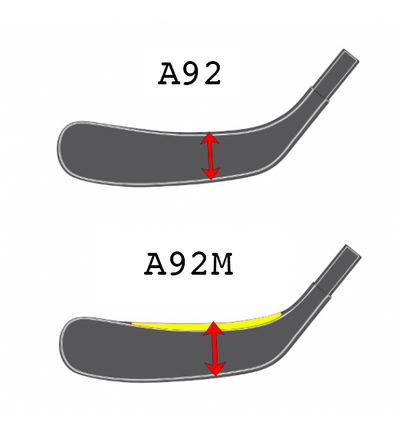
| P92M | 288.6 | 75.6 | 5.0 | 10.8 |
Offset toe measures how far the toe of the blade sits sideways from the shaft axis – the larger the value, the more curve at the toe. Offset mid shows how early the curve starts: a larger value means it begins further back.
The lie is deliberately not in this table: it is not a fixed value per curve but depends on the blade variant. What the number means is explained in the lie guide.
P92 vs. P29: the same basic shape
Offset mid 6.2 against 6.4 mm, offset toe 10.9 against 11.2 mm. The two profiles are 0.2 and 0.3 mm apart, which is within manufacturing tolerance. Moving from a Bauer P92 to a CCM P29 changes the label, not the blade shape.
P92 vs. P28: a similar amount of curve, a different starting point
At the toe there is little between them: 10.9 mm on the P92, 11.6 mm on the P28. The difference sits in the middle – 6.2 against 5.6 mm. On the P92 the curve starts further back; on the P28 it starts further forward and is stronger at the toe. That is the difference between a mid curve and a toe curve, in two numbers.
P92 vs. P92M: same basic shape, taller blade
The P92M is around 1 mm taller than the P92: 75.6 instead of 74.8 mm. Offset mid and offset toe stay in P92 territory. P92, P29 and P28 are available as custom sticks from one piece, while the P92M runs as a Pro Custom Blade from three pieces.
Brand equivalents: P92 ≈ Bauer P92 · CCM P29 · Warrior W03 · True TC2. P28 ≈ Bauer P28 · CCM P28 · Warrior W28 · True TC4.
All curves side by side: curve comparison table.

Advantages of the P92 / P29 at a glance
- The most versatile curve there is – hardly any weaknesses
- Excellent for shooting and passing (especially saucer passes)
- More forgiving than a pure toe curve – also suitable for beginners
- Available on every SOYUZ model (as P29)
Possible drawbacks
- The open face takes some practice on backhand and pass reception
- For extreme toe drags & the fastest release the P28 is more specialised
- For maximum flat, hard slapshots the neutral P88 has the edge
How to configure your SOYUZ with a P29 curve
At ABSHockey you build your stick fully to measure – including the P29 curve, available on every model. After the curve you decide on the two other big variables:
👉 Flex: How much stiffness suits your weight and shooting style? Our flex guide explains it.
👉 Length: Find the right stick length in the length guide.
👉 Overview: All specs in one place in the ABSHockey stick guide.
Ready for your P29?
Configure your SOYUZ in Senior, Intermediate, Junior or Youth – curve, flex, length and name bar freely selectable.
Configure your custom stick → HIT GRIT ARCANEOur verdict on the P92 / P29
There is a reason the P92/P29 is the most popular curve in the world: it does almost everything very well and hardly makes mistakes. For anyone looking for a reliable all-round curve – from beginner to pro – it is the safest choice. If your game is very specific, the specialised P28 (toe/dangles) or the neutral P88 (backhand/control) may fit better. When in doubt: with the P92/P29 you are almost always right.
Frequently asked questions about the P92 / P29
Are the P92 and P29 the same?
Practically yes. “P92” is the Bauer designation, “P29” the CCM one for the same mid profile with an open face. At SOYUZ it runs as the P29 and is available on every model.
Is the P92/P29 suitable for beginners?
Yes, very much so. It is more forgiving than a pure toe curve and covers all fundamental techniques – the ideal first curve. Only the neutral P88 is even more good-natured on the backhand.
What is the difference between the P92/P29 and the P28?
The P92/P29 is a mid curve (central curvature, versatile), the P28 a toe curve (curvature at the toe, specialised for a quick release and dangles).
What is the difference between the P92/P29 and the P90TM?
The P90TM sits between the two: its curvature is further forward than on the P92/P29, giving a faster release and easier puck elevation, but slightly less forgiving passing and pass reception.
Which flex suits the P92/P29?
The curve does not change your flex choice – that depends on weight, height and shooting style. Details in the flex guide.
Is the P92/P29 good for slapshots?
Yes, decent – thanks to the central curvature better than a pure toe curve. For maximum flat, hard slapshots the neutral P88 still has the edge.
More curve guides
- P28 – the toe curve for snipers & danglers
- P90TM – the blend of P28 and P92
- P88 / Kane – the most balanced curve
- P86 / PRO9246 – the hybrid curve for offensive players
- P91A / Drury – the heel curve for power
- Nico Hischier's stick (plays P29)
- Which curve is right for me?
If you are torn between the P92, P29 and P28, put them side by side in the 3D Curve Lab and order the one that convinces you there as a custom stick.


 SOYUZ HIT GRIT
 SOYUZ AURORA
 SOYUZ ARCANE