Lie on a Hockey Stick: The Overlooked Number That Actually Decides Your Shot
Hockey stick lie: the number almost nobody checks – and the one that decides your shot
Last updated: September 2026
Flex? Everyone knows it. Curve? Sure. But lie? Even experienced players often just look confused. Yet lie is one of the factors that most directly decides whether your stick feels "right" – or never quite does. In this guide you get the explanation, three tests you can do at home, a guideline table by height and stance – and something nobody else offers: the lie of all 159 SOYUZ curves from our 3D Curve Lab.

What is lie, exactly?
Lie describes the angle between the shaft and the blade. In plain terms: how steep or flat the blade sits on the ice when you are in your normal playing stance with the blade fully resting on the ice.
The scale usually runs from 4 to 7, in half steps:
- Low lie (4 to 5) = flatter angle, the stick sits more "stretched out". For players who stand more upright, are taller, or carry the puck far from the body.
- High lie (6 to 7) = steeper angle, the blade sits more upright. For players with a deep knee bend, a shorter build, or tight puckhandling close to the body.
- Most players sit between 5 and 6 – and most curves are built exactly there.
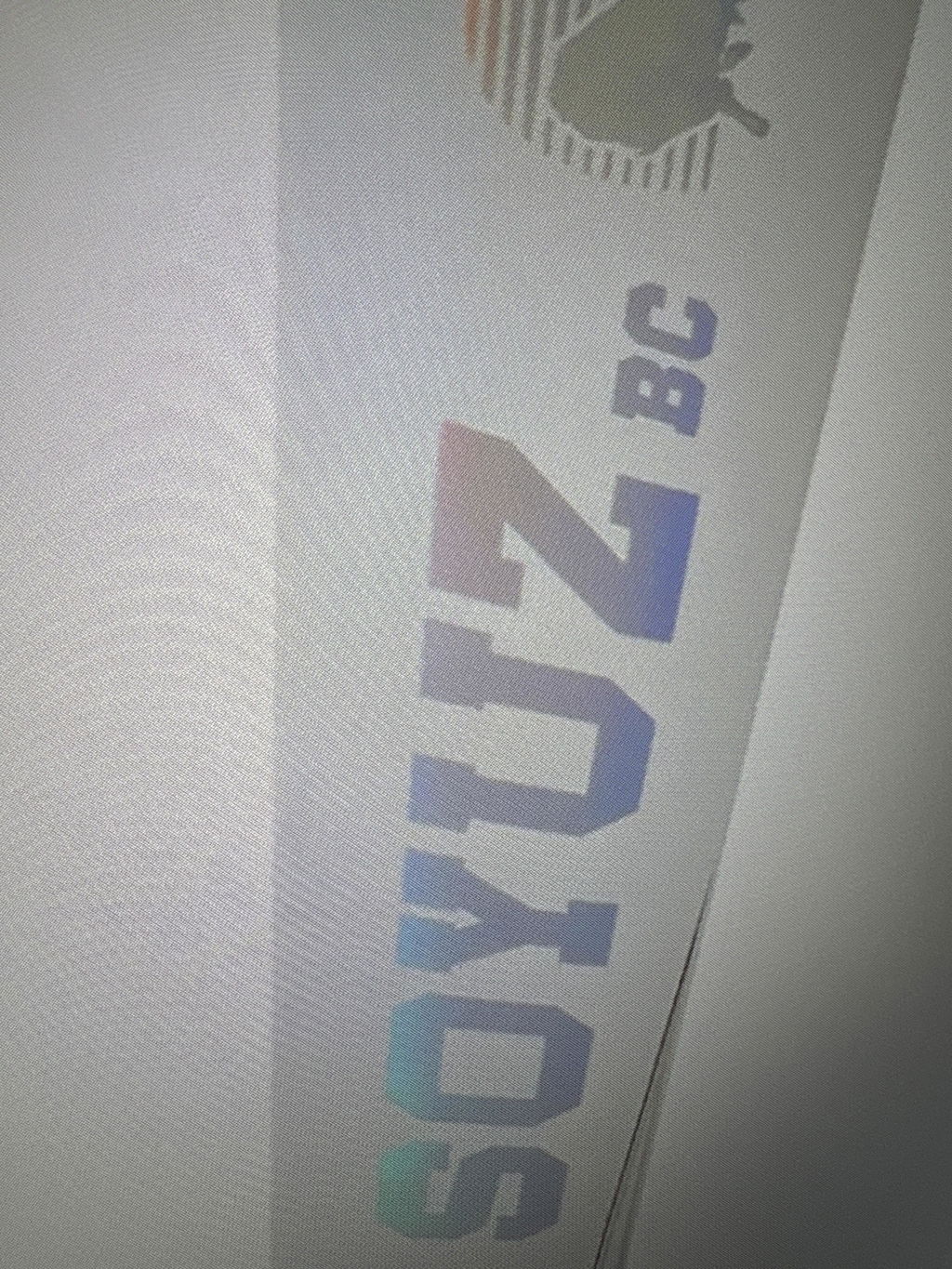
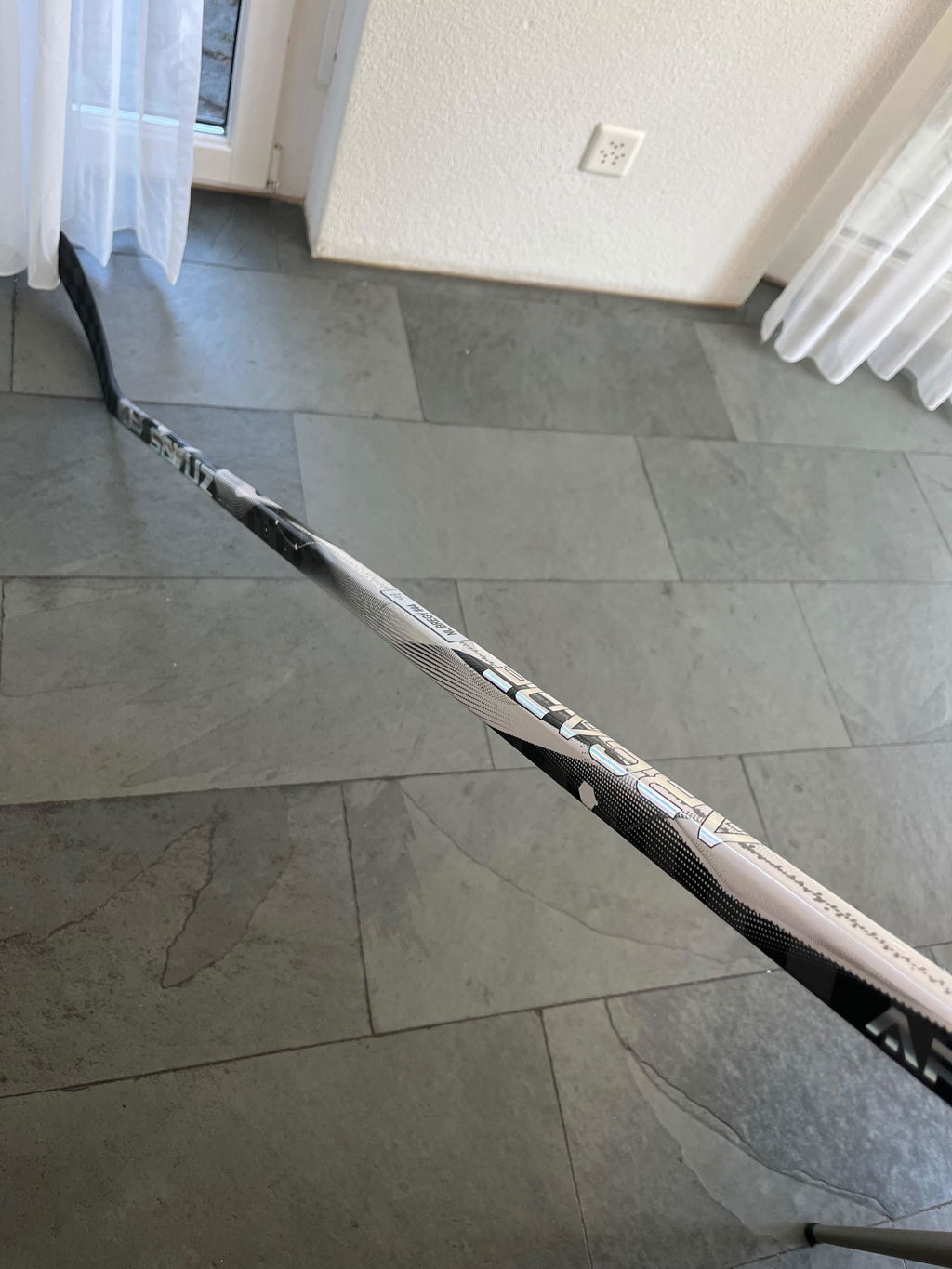
How to read the lie values in our shop: For the standard blades P92, P29, P28, P90TM and P88 we show the number you know from Bauer and CCM – same blade, same angle, same number. SOYUZ itself numbers about one point higher (the P92 blade is printed "LIE 7", which corresponds to the Bauer P92 lie 6). Lie options of these blades therefore show both numbers, e.g. "Lie 7 (SOYUZ 8)". All other pro blades without a retail counterpart carry the SOYUZ number.
Why lie is massively underestimated
Most people choose a stick by brand, flex and maybe curve. Lie just comes along for the ride without ever being chosen consciously. The problem: if the lie does not match your stance, the blade does not sit flat on the ice when you shoot or pass.

- Lie too low for you → the heel of the blade lifts off the ice, you hit the puck more on the toe. Puck control and shot accuracy suffer, passes bounce.
- Lie too high for you → the toe lifts off, you play more on the heel. Shots become inaccurate, handling feels "tight" and unnatural.
The nasty part: many never notice it consciously. They just feel that "something is off", unconsciously adjust their technique – a slightly different knee bend, a different grip – and lose efficiency without knowing why. Lie is the quiet factor behind the sentence "this stick feels weird".
Three tests to find your lie at home
1. The tape test (the most honest one). Look at the tape on the bottom of your current blade after a few practices. Tape does not lie: it is worn exactly where the blade really touches the ice.

- Wear mainly at the toe → your lie is too low. Go 0.5 higher.
- Wear mainly at the heel → your lie is too high. Go 0.5 lower.
- Even wear along the whole length → it fits. Change nothing.
2. The stance test. Stick flat on the ice (or on a smooth floor, on skates or on tiptoes for the height), take your normal playing stance, puck in front of you. Check whether the whole bottom edge of the blade has contact. If only the toe or only the heel touches, the lie is wrong – or the length, more on that in a moment.
3. The video test. Have someone film you from the front during wrist shots and stickhandling. In the freeze frame you see immediately whether the blade tips. This is the test that shows the actual game situation, not just your stance.
Guide values: which lie fits your height and stance?
Lie depends less on your height than on your stance – how deep you sit in your knees and how far from the body you carry the puck. The table is a starting point, not a law.
| Height | Upright stance, puck far out front | Normal stance | Deep knee bend, puck close to the body |
|---|---|---|---|
| up to 165 cm | 5 | 5.5 | 6 |
| 165–180 cm | 4.5–5 | 5–5.5 | 5.5–6 |
| over 180 cm | 4.5 | 5 | 5.5 |
Defensemen with a long stick and an upright stance usually end up at the lower end, technical forwards with a deep stance at the upper end. One more thing: if you love the toe drag, a slightly higher lie often works better, because the toe then stays cleanly on the ice.
Lie and length belong together
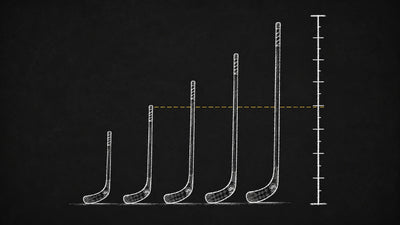
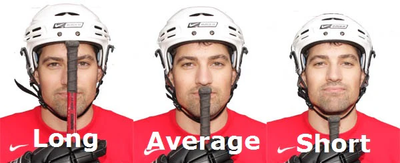
This is the point almost everyone misses: the length of your stick changes the effective lie. A stick that is too long forces you to hold your hands further from the body – the shaft gets flatter, the heel lifts, it looks like "lie too low". A stick that is too short does the opposite: the shaft stands steeper, the toe lifts, it looks like "lie too high".
Hence the order: first choose the right length, then judge the lie. Whoever "corrects" the lie on a stick of the wrong length corrects the wrong problem. How to find your length and what cutting does to the flex is in the size chart and the guide to cutting and extending.
Lie and curve: the lie is built into the blade
Lie is not an option you set separately – it is part of the blade shape. Every curve is built with a specific lie, and the differences are bigger than many think. Here are the most popular SOYUZ curves with the lie as shown in our shop (standard variant) – next to it the designation SOYUZ itself prints on the blade:
| Curve | Lie in shop | SOYUZ designation | Type | In the Lab |
|---|---|---|---|---|
| P92 (Bauer P92 / CCM P29) | 6 | 7 | Mid curve | view in 3D |
| P28 (McDavid / Pastrnak) | 5 | 5.5 | Toe curve | view in 3D |
| P29 (Crosby) | 6 | 7 | Mid curve | view in 3D |
| P90TM (Tavares) | 6 | 7 | Mid-toe | view in 3D |
| P88 (Kane) | 6 | 6 | Mid curve | view in 3D |
| P28M | 6.5 | 6.5 | Toe curve, taller blade | view in 3D |
| P92M (Matthews) | 7.5 | 7.5 | Mid curve, taller blade | view in 3D |
| P29M | 4 / 5 | 4 / 5 | Mid curve, taller blade | view in 3D |
| P86 (Bauer P86 / CCM P86) | 7.5 | 7.5 | Hybrid | view in 3D |
| P90 | 6.5 | 6.5 | Mid curve | view in 3D |
This explains an effect many players know: switch from the P92 to the P29M and you suddenly have a stick that "stands differently" – not because of the curve alone, but because there are a good two full lie steps between the two. And if you compare P92 and P28, you notice the P28 sits one point flatter (5 instead of 6). That is exactly why its toe stays so cleanly on the ice during a toe drag.
How are the values distributed? In SOYUZ numbering, of the 159 curves in the Lab 39 sit at lie 6.5, 34 at 7 and 30 at 6 – so almost two thirds of all blades sit between 6 and 7 (on the Bauer/CCM scale: 5 to 6). 21 are at 5.5, eleven at 7.5, and at the far end there are outliers like the P92B and P12B with lie 8.5 or the P29M and P90M in their lie 4 variant.
Note: blade length, height and face opening in the Lab come from CAD measurement. The lie values are manufacturer specifications – for P92, P29, P28, P90TM and P88 on the Bauer/CCM scale, for all other blades in SOYUZ numbering.
Lie variants: same curve, different angle
Some families offer the same blade shape in several lie variants – that is the way to go when you love your curve but the angle does not fit. In the Lab you see the lie for every variant (for the standard blades on the Bauer/CCM scale, with the SOYUZ designation in brackets):
- P29 in 5.5, 6 and 7 (SOYUZ 6.5 / 7 / 8) → all variants
- P90TM in 5, 5.5 and 6 (SOYUZ 6 / 6.5 / 7) → all variants
- P92 in 6 (junior: 5.5) → all variants
- P90 in 6.5 and 7 (SOYUZ) → all variants
- P28 in 5 (junior: 4 and 4.5) → all variants
- P29M in 4 and 5, P90M in 4 and 7.5 (SOYUZ), P28 +1/4 in 4.5 and 5 (SOYUZ 5.5 / 6)
The standard curves (P28, P28M, P29, P29M, P86, P88, P90TM, P92) can be ordered from a single stick. Lie variants and pro custom blades are available from small minimum quantities – tell us which variant you want and we will tell you what is possible.
👉 Put two curves side by side in the 3D comparison
Switching from Bauer or CCM? This is how you take your lie with you
Take the same curve at SOYUZ that you play today – P92 stays P92, P28 stays P28. The lie comes along automatically because it is built into the blade shape – and in our shop P92, P29, P28, P90TM and P88 carry the same number as at Bauer/CCM, even though SOYUZ labels the blade itself differently (SOYUZ "LIE 7" = Bauer lie 6). What really feels different after switching is usually the kick point or the shaft profile, not the lie. Did you notice toe or heel wear on your old stick? Then now is the moment to correct half a step on purpose – via a lie variant or a neighbouring curve with the right angle. Which curve matches which Bauer, CCM, Warrior or True pattern is in the Curve Compare.
Frequently asked questions about lie
What does "lie 5" actually mean?
On the Bauer/CCM scale, lie 5 is the middle of the scale and the most common value of all: the blade sits at a medium angle to the shaft. Our standard blades use the same scale; on the SOYUZ pro blades the same angle is called lie 6, because SOYUZ numbers about one point higher. If you have no reason to deviate, the standard variant of your curve is the safe start.
Does cutting change the lie?
Not the angle built into the blade – that is fixed. But it does change the effective lie on the ice: a shorter stick stands steeper, the toe lifts more easily. So set the length first, then check the lie. And remember: cutting also makes the stick stiffer, see the flex guide.
How do I recognise a wrong lie in a game?
Passes that bounce or come in too high despite clean technique. Wrist shots that flutter. A puck that keeps "tipping" over the toe or heel while stickhandling. And the surest sign: one-sided tape wear at the toe or heel.
Which lie do the pros play?
Almost all between 5 and 6, most of them at 5 to 5.5 – the extremes are rare. What matters more for pros than the nominal value: they tune length, lie and curve together instead of changing one variable in isolation. That is exactly what you can do with a custom stick.
Can I choose the lie freely at SOYUZ?
Lie is part of the curve: you choose the blade, and the lie is defined with it. If you want your curve with a different angle, several families offer lie variants (see above). In the Curve Lab you find the lie of every single blade.
Lie or curve – which do I decide first?
First the length, then the curve, then the lie as fine tuning. The curve determines how you shoot and pass; the lie makes sure the curve actually arrives flat on the ice. A perfect curve with the wrong lie is like a good shoe in the wrong size.
Conclusion: the quiet factor that often makes the difference
Flex gets all the attention, curve is the cool factor – but lie decides whether your blade sits on the ice properly at all. Do the tape test, check the length first, and then look up where your curve sits in the Lab. With that you will know more about your lie at your next stick purchase than most players in your league.
👉 To the Curve Lab: lie of all 159 curves in 3D
👉 Curve Guide: which blade suits you?
👉 Configure a custom stick with your curve, length and flex
Further guides & configuration
Lie is one piece of a well-tuned stick. Also relevant: which curve suits your game, which flex you need, the size chart by height and weight, how to cut or extend correctly and what the kick point does.


 SOYUZ HIT GRIT
 SOYUZ AURORA
 SOYUZ ARCANE