Goalie Stick: How to Find the Right Paddle Length
Goalie Stick: How to Find the Right Paddle Length
With a player stick, everything revolves around flex, length and blade. With a goalie stick, the decisive number is a different one: the paddle length. It determines whether you stand cleanly in your stance – or whether you have to compensate for the whole game.
And it gets chosen wrong surprisingly often. Usually because it is confused with the total length of the stick.
What is paddle length – and what is it not?
The paddle length is the wide, flat part of the shaft between the blade and the point where the shaft becomes narrow. It is given in inches – typically between 21" and 27".
It is not the total length of the stick. You can shorten the total length at the top if you need to. The paddle length, by contrast, is fixed and cannot be changed afterwards. That is why it is the number you have to get right when you buy.
Why this matters so much: the paddle determines how high your blocker hand sits when the blade lies flat on the ice. If the length is right, your stance falls into place by itself. If it is not, you either get gaps under the blocker or you end up permanently hunched over.

How to measure correctly
The most common measuring mistake is holding the stick in the living room in your socks. That almost always leads to a size that is too short. Do it like this instead:
- In full gear. Pads, pants, chest protector, blocker – everything on. The equipment changes your stance noticeably.
- On your skates. Blades lift you several centimetres higher.
- In your real stance. Not standing upright, but the way you actually stand in a game.
Then check two things: does the blade lie flat on the ice – not just on the toe or only on the heel? And is your blocker arm relaxed while doing so, without pulling up your shoulder or stretching? If both are true, the length is right.
Table: height and paddle length
These values are a starting point, not a rule. In the end your stance counts for more than your height – if you play very low, you tend to need a shorter paddle; if you stand more upright, a longer one.
| Height | Paddle length | Category |
|---|---|---|
| up to approx. 120 cm | 21" | Junior |
| approx. 120–140 cm | 23" | Junior |
| approx. 140–155 cm | 24" | Intermediate |
| approx. 155–170 cm | 24"–25" | Intermediate / Senior |
| approx. 170–183 cm | 25"–26" | Senior |
| over 183 cm | 26"–27" | Senior |
If you are between two sizes, your stance decides. When in doubt, and with growing juniors, most people do better with the smaller size: a slightly too short paddle can be compensated with your stance, a too long one cannot.
Our LORD goalie sticks at a glance
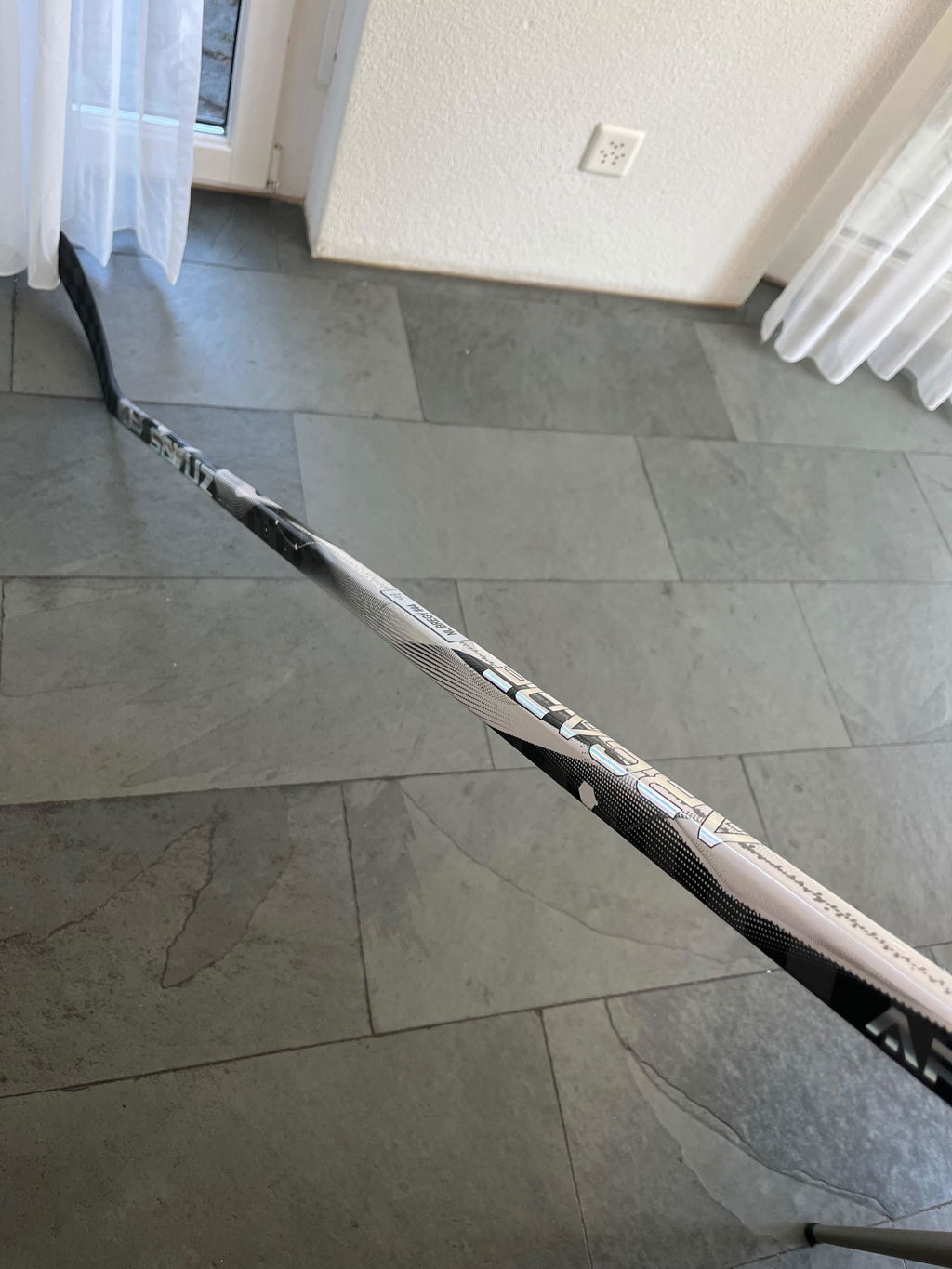
Our custom goalie stick SOYUZ LORD is available in these sizes – in white or black, with the P31 blade:
| Category | Paddle length | Weight |
|---|---|---|
| Junior | 21" / 23" | lighter, for growing players |
| Intermediate | 24" | approx. 625 g |
| Senior | 25" | approx. 635 g |
| Senior | 26" | approx. 645 g |
| Senior | 27" | approx. 655 g |
As you can see: the weight increases with the paddle length – more material means more grams. A difference of 10 to 20 grams sounds like nothing, but you feel it over 60 minutes. Another reason not to buy a size up just to be safe.
👉 View the SOYUZ LORD goalie stick
Regular or Full Right? The most common mix-up
Besides the paddle length, you have to state which hand you catch with. This is where most wrong orders happen – partly because two different naming systems are in circulation in the trade.
| Designation | Catch glove hand | Stick hand | Alternative notation |
|---|---|---|---|
| Regular | left | right hand on the stick | „L“ |
| Full Right | right | left hand on the stick | „R“ |
The memory aid: the designation follows the catch glove hand, not the stick hand. So „Full Right“ means: you catch with your right and hold the stick with your left. Around 85 to 90 percent of all goaltenders play Regular – if you are unsure, that is the more likely option. But you only know for certain once you look at your catch glove.

How to tell the length is wrong
Signs of a paddle that is too long
- Your blocker hand sits clearly higher than your catch glove hand, even though you are standing normally
- The blade only rests on the heel, the toe hangs in the air
- A gap opens up under the blocker that pucks slip through
- You have to lean unnaturally far over the stick when passing
Signs of a paddle that is too short
- You have to crouch noticeably lower for the blade to lie flat
- The blade only rests on the toe
- Your back hurts more than usual after practice
- You cannot get any power behind the puck when clearing
If you are unsure, an outside view helps more than any table: have your goalie coach or a teammate photograph you in your stance. In the picture you will see within two seconds whether the blade lies flat.
What else you should consider
The Lie. It describes the angle between paddle and blade and is part of what decides whether the blade lies flat. On goalie sticks it is much flatter than on player sticks. The standard value suits most goaltenders – if your blade rests at an angle despite the correct paddle length, it is worth a look at the Lie guide.
The weight. A lighter stick reacts faster, a heavier one sits more steadily. Weight counts double for juniors: a stick that is too heavy costs reaction speed and tires the stick hand.
Common mistakes
❌ Confusing the total length with the paddle length
❌ Measuring without gear and skates
❌ Buying juniors room to grow – a paddle that is too long ruins the stance at exactly the age when it gets ingrained
❌ Copying a pro's stick
✅ Measure in full gear, on the ice, in your real stance
✅ When in doubt, take the smaller size
✅ Double-check your catch glove hand before you order
In short
The paddle length is the one number on a goalie stick you cannot correct afterwards. Measure in full gear on the ice, check that the blade lies flat and your blocker arm stays relaxed, and when in doubt lean towards the smaller size. And look twice at your catch glove hand.
👉 To the SOYUZ LORD goalie stick
Further guides
Also relevant: left- or right-handed player sticks, the lie angle explained and our big stick guide.

 SOYUZ LORD
 Ice hockey goalie stick SR
 SOYUZ HIT GRIT
 SOYUZ AURORA