Goalie Stick: Regular or Full Right? How to Find Your Side
There is one mistake that happens more often with goalie sticks than with any other piece of equipment: ordering the wrong side. And unlike flex or blade, it is not something you can adapt to. A stick for the wrong side is unusable.
The reason is a label that at first glance means the opposite of what you would expect.
Regular or Full Right – the two options
Goalie sticks come in exactly two versions, and the entire industry uses the same names:
- Regular – the catching glove hand is the left one. The stick is in the right hand.
- Full Right – the catching glove hand is the right one. The stick is in the left hand.
About nine out of ten goalies play Regular. That is exactly why it is called that: it is the standard case, not a characteristic of the player.
The thinking error behind the wrong orders
“Full Right” sounds like “right-hander”. That is the mistake. A right-hander usually plays Regular – he holds the stick in his stronger right hand and catches with the left.
The comparison with skaters does not help either. For a skater, “left” or “right” describes where the lower hand sits on the shaft. For a goalie, the label describes which hand the catching glove is on. Two different systems, the same words.

And because you rarely say it out loud when ordering, the mistake often only shows up once the stick has arrived.
How to find out in five seconds
Forget the terms for a moment and look at the equipment:
- Catching glove on the left hand → you play Regular
- Catching glove on the right hand → you play Full Right


If there is no equipment nearby: the stick belongs in the hand you also use to play the puck and make passes. The other hand catches. With kids who have not settled on a side yet, the catching glove hand usually decides – try the glove on first, then order the stick to match.
Why the labels get mixed up in retail
Some shops write “Regular” and “Full Right”, others only “L” and “R” – and one shop's “L” means the catching hand while the next one means the hand on the stick. Both are common, and each one is logical on its own. It is just that the same letter then means the opposite.
So the simplest way to handle it: never rely on the letter alone. Look for the word “catching hand” or “catch”. If it is not there, ask. A short email is cheaper than a stick you cannot use.
In our shop
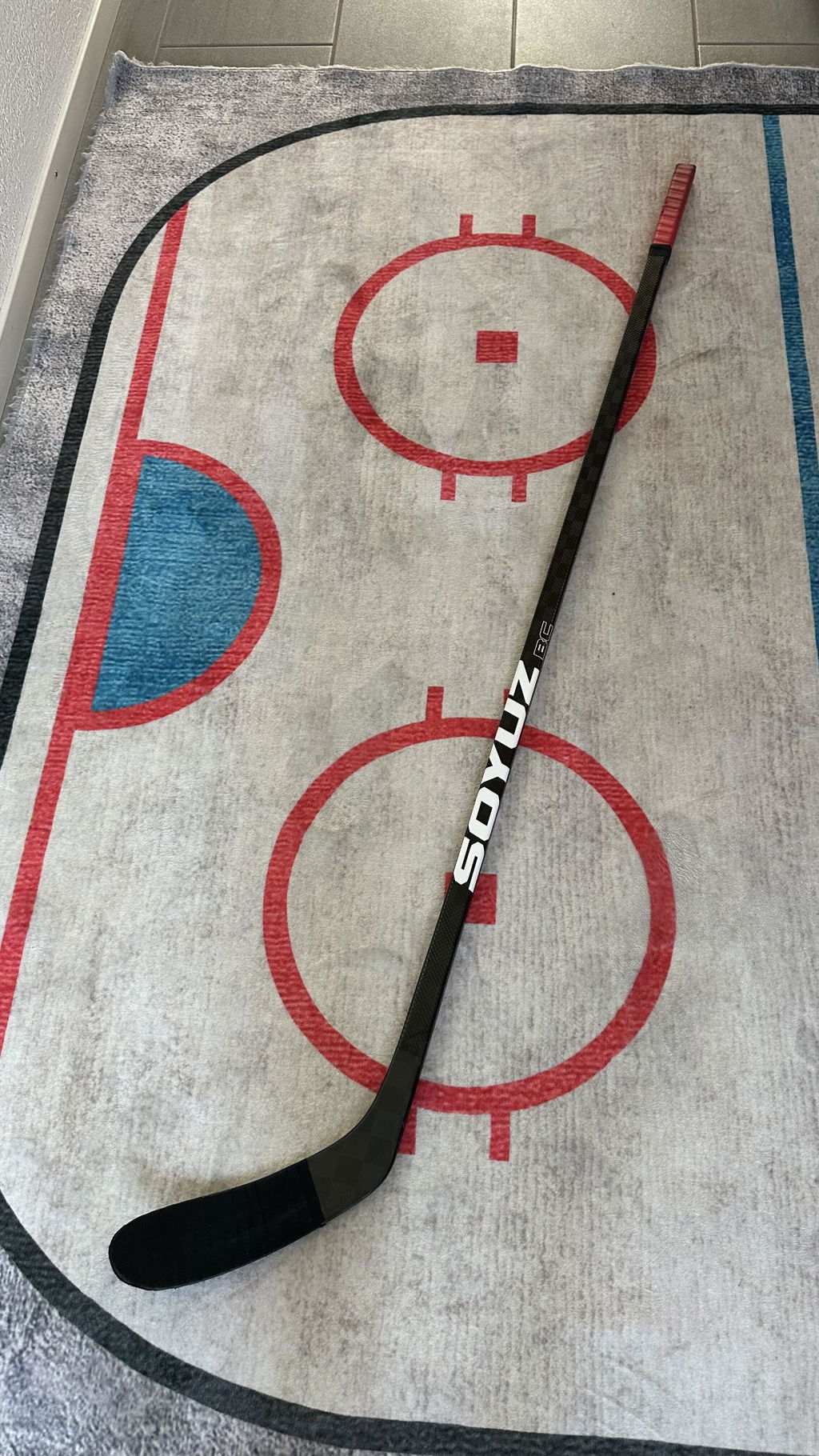
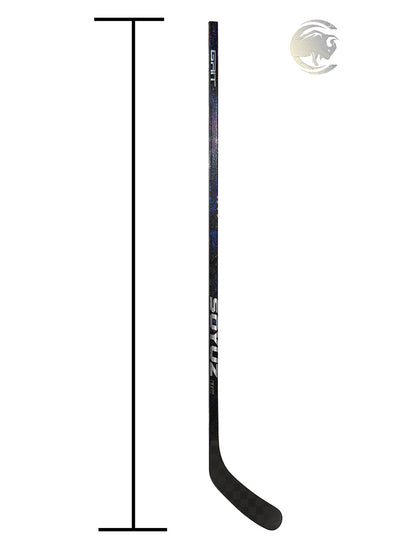
With the SOYUZ LORD Custom Goalie Stick the catching hand is stated right in the option: Regular · catching glove left or Full Right · catching glove right. Nothing can go wrong there.
The second decision on a goalie stick is paddle length – we have a separate article on that: How to find the right paddle length.
If you are still unsure, drop us a line before you order – we will sort it out in two sentences. This is the one question where we would rather ask once too often.
And the blade?
With goalie sticks the blade question is far simpler than for skaters. There is essentially one pattern in use: the P31. It is built for what a goalie actually does with the stick – playing the puck out of the corner, controlling rebounds, the long pass out of the slot. The catching glove hand determines which orientation the P31 is built in, and there is nothing more for you to decide.

The three most common mistakes
- Deriving it from the writing hand. Whether someone is right- or left-handed says little for a goalie. There are left-handers who play Regular and right-handers with Full Right.
- Deriving it from the skater stick. Someone who plays a left-handed skater stick is not automatically Full Right as a goalie. The one has nothing to do with the other.
- Deciding by availability for youth players. Full Right is rarer and therefore harder to get. But that is no reason to retrain a child to Regular if they naturally catch right – the side is not a matter of taste.
In short
Look at which hand the catching glove is on. Left means Regular, right means Full Right. Everything else – letters, writing hand, the comparison with the skater stick – leads you astray.

 SOYUZ LORD
 Ice hockey goalie stick SR
 SOYUZ HIT GRIT
 SOYUZ AURORA