Left-handed or right-handed? How to find your shooting side
Left-handed or right-handed? How to find out which side suits you
Before you decide on flex, length or blade, there is one question you need to answer first: do you shoot left or right? This decision comes right at the very beginning – in the configurator it is the first thing we need to know from you – and it cannot be corrected later. A hockey stick is not a frying pan that you can simply hold the other way round.
The good news: you can figure it out in five minutes, without ever setting foot on the ice.
What do left-handed and right-handed actually mean?
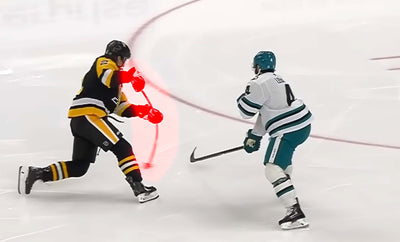
Unlike writing, tennis or football, the side in ice hockey does not describe which hand is the stronger one. It describes where your hands sit on the stick.
| Side | Top hand (butt end) | Bottom hand | Blade points |
|---|---|---|---|
| Left-handed shot (LH) | right hand | left hand | to the left |
| Right-handed shot (RH) | left hand | right hand | to the right |
The easiest thing to remember is the bottom hand: lefties have their left hand at the bottom, righties their right one. That is the definition we mean on every order, too.
Left-handed LH
around 68% of our orders
Right-handed RH
around 32% of our orders
It matters because the blade is curved – and only in one direction. A left-handed stick simply does not work for a righty.
The most common mistake: your writing hand is not your shooting hand
This is the mistake we hear most often: “I am right-handed, so I need a right-handed stick.” Unfortunately it is not that simple – and quite often the exact opposite is true.
The reason lies in how the two hands share the work on the stick. The top hand steers, turns and controls the blade; it does the fine work when stickhandling. The bottom hand mainly delivers power. If you have your more skilful hand on top, you play with cleaner technique – and for many right-handed people that means: right hand on top, so a left-handed shot.
That is exactly why the majority of players in Canada shoot left, even though most people are right-handed. We see it clearly here as well: across all custom orders so far, around 68 % are left-handed shots and 32 % right-handed shots – a good two thirds to one third.
Even so: there is no right or wrong. There is only the side that feels natural to you.
Three tests that give you clarity in five minutes
Test 1: The broom test – the most reliable one
Grab a broom, a mop or a stick and sweep the floor with it – without thinking about it. Then stop and take a look at your hands.
If your right hand is on top, you are very likely a left-handed shot. If your left hand is on top, everything points to a right-handed shot.
The trick is the “without thinking about it”. As soon as you start thinking it over, you skew the result. It is best to ask someone to simply put the broom in your hands.
Test 2: The toss
Have someone toss a stick to you and catch it. The way you then grab it automatically matches your natural side in the vast majority of cases. The same rule applies here: the first grip counts, not the second.
Test 3: The axe or the shovel
Imagine you are splitting wood or shovelling snow. Both movements match the hockey stance remarkably closely. Which hand slides down? That hand determines your side.
If all three tests point to the same result, you can order with confidence. If they contradict each other, go with the result of the broom test – it comes closest to the movement you make when stickhandling.
For parents: working out your child’s side
With your child’s first stick, the temptation to go by their writing hand is strong. Do not do it – for the reasons above, it is often wrong.
- Observe instead of correcting. Put a stick in your child’s hands and watch how they grab it on their own. Children almost always pick their natural side intuitively and correctly.
- Test it playfully. A few balls in the garden are enough. On which side does the movement look smoother and less tense?
- Ask the coach. Anyone who is regularly on the ice with kids usually spots it within a few minutes.
- Do not correct them. If your child plays left even though they write with their right hand, that is completely normal and not a mistake.
And one practical note: do not switch sides once your child has played a season or two. The switch costs more than it will ever pay back.
Common mistakes you can spare yourself
❌ Going by your writing hand – the classic, and wrong in a good half of all cases
❌ Using a teammate’s stick as your benchmark
❌ Thinking it over for a long time instead of simply grabbing
❌ Choosing the side because “most people play left”
✅ Going with the first, spontaneous grip – it is almost always the right one
✅ Doing several tests if in doubt
✅ Asking us quickly if you are unsure, before you order
And what if I got it wrong anyway?
Then unfortunately the stick cannot be turned around. The blade is curved, the shaft is built for the load on one side, and a printed name sits the right way round for that side as well. A left-handed stick stays a left-handed stick.
That is exactly why this is the one question in the configurator where we advise you to look twice. You can adjust the flex on your next stick and the length can be cut down – the side cannot.
A quick note for goalies
For goaltenders the logic works differently. There you do not talk about left- or right-handed shots but about the catch glove hand – and the terms “Regular” and “Full Right” regularly cause confusion. If you are looking for a goalie stick, you will find the explanation in our goalie stick guide.
Ready for your stick?
You now know your side – which means the most important decision is made. Everything else, from flex to length to blade, can be fine-tuned at your leisure.
👉 Configure your custom stick now
Further guides
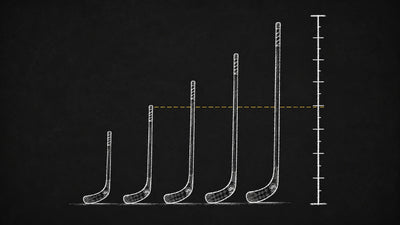
This article is part of our big ice hockey stick guide. Next up: the right flex, the right length and the matching blade.


 SOYUZ HIT GRIT
 SOYUZ AURORA
 SOYUZ ARCANE