Which Hockey Stick Fits Your Position? Defensemen, Centers & Wingers
Which Hockey Stick Fits Your Position? Defensemen, Centers & Wingers
“I'm a defenseman – which stick do I need?” is one of the questions we get most often. The honest answer first: your position is a starting point, not a law. In the end, your shot type and playing style decide – but position is a very good first filter, because it usually determines which shots you take most often.
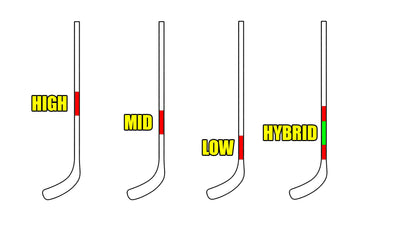
Position influences four things: the kick point (which shot gets rewarded), the curve (what the blade is built for), the length (reach vs. handling) and the flex. Let's go through the three positions.
Defensemen: pressure from the blue line
The typical defenseman's game: slap shots and one-timers from the blue line, long breakout passes, reach in battles. For that you want a shaft that loads deep and releases its energy in one concentrated burst.
Kick point: mid or high. The MASTER FRST (mid kick, CCM T-style – if you know the Tacks, you know the feel) is built for hard slap shots from the blue line. The CLASSIC SPR (high kick, like the Bauer Nexus) goes one step further: the whole shaft loads, the energy comes late and concentrated – and it's also the stiffest and most robust stick in our line-up, which is no disadvantage in a physical defensive game.

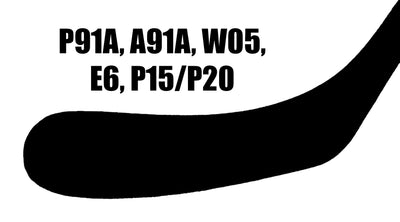
Curve: classic defensemen often reach for the P02 (heel curve with a long blade – the Lidström/Kronwall pattern: lots of surface, stable puck reception, long passes). More offensive defensemen also often play the P90TM or the P29 +1/4. And if someone tells you the P28 is “not for defensemen”: we consider that claim unproven – the details are in our blade guide.
Length & flex: defensemen usually go with a longer stick (reach for poke checks and intercepting passes) and a rather higher flex – if you take a lot of slap shots, the higher of two values usually serves you better. The basics are in the flex chart.
Centers: the all-rounder
The center does everything: faceoffs, backchecking, passing in both directions, finishing from the slot. A stick that specialises in a single strength is out of place here.
Kick point: hybrid. The HIT GRIT (hybrid kick, CCM R-style) is our most requested model for exactly this – quick enough for the snapshot, powerful enough for the one-timer. Centers who finish mainly through quick releases go for the low-kick camp (AURORA) or ultra-low (ARCANE).

Curve: the P92/P29 is the most versatile curve in hockey and our standard recommendation for all-rounders. Centers with lots of net-front work and a faceoff focus should look at the P29 +1/4 – same base shape, more blade surface for faceoffs, tip-ins and deflections. Modern and versatile: the P90TM.
Length & flex: standard dimensions per the size chart – the center needs the compromise between reach (defense) and handling (offense).
Wingers: release wins
Wingers live off finishing in motion: wrist shots from the half-wall, snapshots before the goalie is set, tight plays along the boards. What counts here is how fast the puck leaves your blade.
Kick point: low or ultra-low. The ARCANE (ultra-low, T1100 carbon) is our top model for explosive players – the release comes without warning. The RAPID offers the same base with an ergonomic D-shaft for skill players who work through control and precise passes. Price-conscious wingers are very well served by the AURORA (low kick).

Curve: the P28 is one of the most popular offensive curves of recent years – aggressive toe, explosive release, perfect for toe drags. It does demand clean technique, though. Technically oriented wingers with a strong passing game and backhand do very well with the P88 (Kane curve), and the P92 remains the safe all-round choice here too.
Length & flex: many wingers play slightly shorter and softer – faster handling, faster release. How much cutting a stick down changes the flex is explained in our cutting guide.
The overview
| Position | Typical game | Kick point | SOYUZ models | Typical curves |
|---|---|---|---|---|
| Defenseman | Slap shots, one-timers, long passes | Mid / High | MASTER FRST · CLASSIC SPR | P02 · offensive: P90TM, P29 +1/4 |
| Center | Faceoffs, passing, everything | Hybrid | HIT GRIT | P92/P29 · P29 +1/4 · P90TM |
| Winger | Quick finish, 1-on-1 | Ultra-low / Low | ARCANE · RAPID · AURORA | P28 · P92 · P88 |
When to break the position rule
The table is a tendency, not a rule book. A modern offensive defenseman who works a lot with wrist shots through traffic is often better served by a hybrid or even low-kick stick than by the classic high kick. Conversely, there are power wingers who play their one-timer through a mid kick. If your playing style and your position contradict each other, the playing style wins – the kick point guide helps you figure it out.
How to get to your stick
The fastest way: take the 2-minute stick finder – it asks about size, what you're used to, shot type and budget, and suggests the right model. Then check your flex with the flex chart, your length with the size chart, your curve with the curve guide – and off to the configurator. If you don't want to wait: the most popular configurations are available in stock, delivered in 1–3 business days within Switzerland and 3–5 across Europe.
 SOYUZ HIT GRIT
 SOYUZ AURORA
 SOYUZ ARCANE