P90TM Curve Measured: What It Really Has in Common with the P29, P28 and P90
Last updated: 20 October 2026 · by Andri Farrer
Everyone sells the P90TM the same way: "a mix of the P28 and the P92". We measured the SOYUZ blade and cross-checked every claim against Bauer, CCM, Hockey Stick Man and Pro Stock Hockey Sticks. The verdict: the mix is real – but it sits in one very specific spot. In this guide we cover what the P90TM really is, how close it sits to the P29, what the P90 (the "McDavid question") is all about, and who the Tavares curve is actually for.
What is the P90TM?
The P90TM is a retail blade pattern with an open face and a round toe, known as the "Tavares curve". The brands don't describe it quite the same way: Bauer lists it as a mid-toe curve with medium length and lie 6 and says it combines "the consistency of a P92 with a more aggressive toe like the P28" (Bauer blade pattern guide). CCM lists it under John Tavares as a mid curve with a long blade and lie 5 (CCM curve chart at Inline Warehouse). Hockey Stick Man classifies the CCM P90TM as mid-toe (HSM blade chart).
The name causes a lot of confusion. According to Hockey Response, Bauer and CCM call it P90TM, and the non-max-height version P90T; True calls it T90T. Hockey Stick Man puts the Bauer P90T and the CCM P90TM on the same reference blade. Warrior's equivalent is the W90TM. Important for you: the P90TM and the P90 are not the same blade – more on that below.
At ABSHockey the P90TM is available as a custom blade from 1 stick on every SOYUZ custom model. In our former ABSHockey house brand the same shape was called A90TM – a few remaining sticks are still available in stock.
The measurements: P90TM vs P29 vs P90 vs P28
All values come from SOYUZ's CAD data, exactly as shown in our Curve Lab. We compare the standard blades (ST).
| Blade | Blade length | Height | Face curve (depth) | Openness mid | Openness toe |
|---|---|---|---|---|---|
| P90TM | 285.3 mm | 74.2 mm | 12.0 mm | 6.6° | 11.1° |
| P29 | 285.3 mm | 74.2 mm | 12.1 mm | 6.4° | 11.2° |
| P90 | 288.1 mm | 75.2 mm | 9.6 mm | 6.8° | 11.3° |
| P28 | 273.1 mm | 74.1 mm | 11.2 mm | 5.6° | 11.6° |
Source: SOYUZ CAD data (Curve Lab), standard blades ST. Lie is deliberately not in this table – what lie means and which one you need is covered in our lie guide.
What the numbers say
1. The base is a P29. Length (285.3 mm), height, curve depth (12.0 vs 12.1 mm) and openness (6.6° vs 6.4° at the mid, 11.1° vs 11.2° at the toe) are practically at P29 level. So the P90TM is not a middle ground between the P29 (285 mm) and the P28 (273 mm) – it is a full P29 blade. At retail the CCM P90TM is known as a slightly taller blade; the SOYUZ version is exactly as tall as the P29 at 74.2 mm.
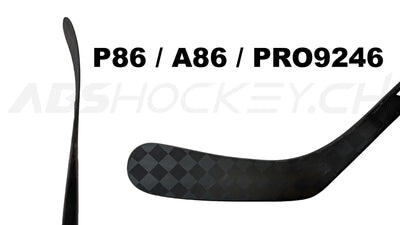
2. The P28 lives in the toe – and that's exactly what these numbers don't capture. The P90TM toe is fuller and squarer than the P29's, as you can see in the SOYUZ renderings below. That's how Bauer describes it ("a more aggressive toe like the P28"), and the HockeyReviews test came to the same conclusion in a direct CCM comparison: P28 toe on a P29 blade. Our measurements don't capture the shape of the toe. That's why the P90TM and P29 look almost identical on paper but feel different on the ice – especially on toe drags and shots off the toe.
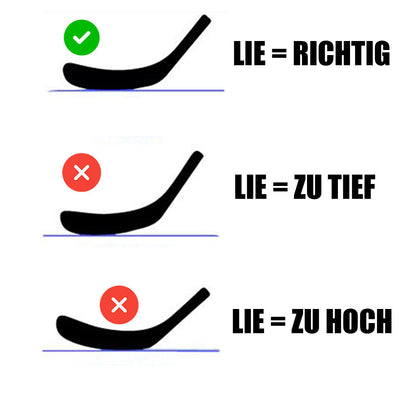
3. The lie depends on the brand. At CCM the P90TM is lie 5 and the P29 lie 6 – so the CCM P90TM sits flatter. Bauer lists both the P90TM and the P92 at lie 6. With us, lie 6 (SOYUZ 7) is standard and lie 5.5 (SOYUZ 6.5) is available as an option. If you're coming from a CCM P90TM and skate low, the 5.5 is the closer match.
4. The P90 is the flat sibling. With 9.6 mm of curve depth, the P90 is about 2.5 mm flatter than the P90TM and P29, with almost the same openness. It is a blade for control, backhands and passing, not a sniper blade.
5. The full P28 is a different blade. 12 mm shorter, less open at the mid (5.6°), most open at the toe. If you want the whole toe curve and not just a P28-style toe, you end up with the P28.

Compare them yourself: P90TM vs P29 in 3D · P90TM vs P28 · P90 vs P90TM
What about the CLASSIC SPR?
The CLASSIC SPR uses its own blade construction, and there the P90TM turns out a little different: 12.9 mm of curve depth versus 11.5 mm for the P92 on the same model, so just over 1 mm deeper. If you specifically want the P90TM as "a bit more curve than a P92", the CLASSIC SPR is where you'll find it. Lie there is 5.5 (SOYUZ 6.5); on the other models it is 6 (SOYUZ 7).
P90TM vs P90: the McDavid question
Hardly any question reaches us as often as: "What curve does McDavid use?" The honest answer: sources contradict each other, and pros change their pro blades all the time.
- Hockey Stick Man describes, in his spec check (March 2026), a CCM Super Tacks with a shortened, P92-style custom blade, flex 85, 64 inches long (source).
- Pro Stock Hockey Sticks says McDavid used an Iginla-like pro blade from juniors until 2020 and then switched to the P90 (source).
- HockeyMonkey, in January 2025, lists the P90TM on a Ribcor Trigger 9 Pro for McDavid instead (source).
- The P28 is still marketed as "McDavid" at retail – that is also how CCM's curve chart lists it.
Our take: within the SOYUZ range, the P90 comes closest to the McDavid shape, which matches Pro Stock Hockey Sticks – that's why searching "McDavid" in the Curve Lab takes you there. We assign the P90TM to Tavares. And for your own game, the name matters less anyway: what counts is whether you want a deep mid curve (P90TM/P29) or a flatter blade (P90).

How does the P90TM play on the ice?
Because the P90TM matches the P29 in depth and openness, it plays similarly versatile – with a bit more feel at the toe. Here's how we rate it:
Rating by the ABSHockey team based on blade geometry and customer feedback. 5 = outstanding, 1 = weak.
Who is the P90TM for – and who should skip it?
| ✅ The P90TM suits you if … | ❌ Probably not if … |
|---|---|
| you like the P29/P92 but want more surface at the toe | you want the maximum toe release (→ P28) |
| you shoot a lot in motion and from the slot | you want a flat, neutral blade for slapshots (→ P88) |
| you love toe drags and tight moves | you play a lot on your backhand (→ P90 or P88) |
| you're coming from a Bauer/CCM P90TM | you need a stick in stock right now (→ P28/P29/P86 in stock) |
Self-check: what type of player are you?
"I play P92/P29 and want to try something different"
The P90TM is the gentlest switch there is. Depth and openness stay almost the same, only the toe feels different. No weeks of adjusting. Compare in the Curve Lab →
"I'm a sniper – I want the fastest release"
Good choice, but not the most extreme one. If you really want more toe, the P28 is the more consistent blade.
"I'm a playmaker or a defenseman"
Take a look at the P90. It is flatter and more forgiving on backhands and receiving passes. Alternatively, the neutral P88.
"I'm just starting out"
It works – the P29 is still the better pick. Since the blades are almost the same, the difference is small. But you can get the P29 in stock right away on every SOYUZ model.
Does John Tavares really use a P90TM?
CCM and Hockey Stick Man link the P90TM to Tavares, hence the name "Tavares curve". For context: pros almost always play individually tweaked pro blades, so a retail P90TM is not necessarily identical to what ends up on NHL ice. How far retail and pro specs can drift apart is explained in our guide to dressed sticks and pro stock specs.
P90TM at ABSHockey: lie, sizes, delivery time
- Lie: 6 (SOYUZ 7) as standard, 5.5 (SOYUZ 6.5) as an option and on the CLASSIC SPR. More in our lie guide.
- Ordering: custom from 1 stick, left and right, production 4–6 weeks.
- In stock: the SOYUZ P90TM is currently not in stock. The P28, P29 and P86 ship right away – and by the numbers, the P29 is the closest alternative. A few A90TM sticks from our former house brand are in the in-stock collection.
- Popularity: over the last 90 days, roughly every 14th SOYUZ stick we shipped had a P90TM (7%). The most chosen blades are still the P29 and P28.
- The P90 is available as a Pro Custom Blade from 3 sticks – ideal for team orders.
Flex and length are the other two big settings: flex guide · length guide.
Ready for your P90TM?
Custom from 1 stick – flex, length and the name on the shaft are up to you. Not sure about the model? The Stick Finder helps in 5 questions.
Build your custom stick → Stick Finder Shop in stockOur verdict
The P90TM is exactly what Bauer promises: a P92/P29 with a P28 toe. By the numbers, the P29 share is bigger than most people think – the P28 only lives up front. That makes it the ideal blade for anyone who is basically happy with the P29 but wants more surface up front for toe drags and shots in motion. If you're after a true toe release, take the P28. If you want control, the P90.
P90TM FAQ
Is the P90TM a mix of the P28 and P92?
At its core, yes: Bauer describes it as a P92 with a more aggressive toe like the P28. Our CAD measurement shows that length, height, curve depth and openness are at P29 level – the P28 part is the shape of the toe.
What is the difference between the P90 and the P90TM?
With 9.6 mm of curve depth, the P90 is clearly flatter than the P90TM (12.0 mm), and slightly longer and taller. The P90 is the control blade, the P90TM the shooting blade.
What is the difference between the P90T and the P90TM?
According to Hockey Response, the P90T is the non-max-height version of the same blade; Hockey Stick Man puts both on the same reference blade. We only offer the P90TM.
What curve does Connor McDavid use?
Sources contradict each other (a P92-style custom blade, the P90, the P90TM, the P28 at retail). According to Pro Stock Hockey Sticks he has used the P90 since 2020 – within the SOYUZ range, the P90 comes closest to the McDavid shape.
What lie does the P90TM have?
With us, lie 6 (SOYUZ 7) as standard and lie 5.5 (SOYUZ 6.5) as an option, 5.5 on the CLASSIC SPR. At retail: Bauer lie 6, CCM lie 5.
Are the P90TM and A90TM the same?
Yes. A90TM was the name in our former ABSHockey house brand. At SOYUZ the blade is called P90TM.
Is the P90TM available in stock?
Not at SOYUZ right now – it's made as a custom stick from 1 piece (4–6 weeks). The P29 is the closest in-stock alternative.
Which Warrior or True blade matches the P90TM?
Warrior W90TM and True T90T. The Curve Lab shows the comparison across all brands.



 SOYUZ HIT GRIT
 SOYUZ AURORA
 SOYUZ ARCANE