Which Hockey Stick Flex Is Right for You? The Flex Chart
Which flex suits you – and why it matters so much in hockey
Last updated: September 2026
Whether you're just getting into hockey or buying your child their first stick – one of the most important questions is: Which flex is the right one?

The flex of your hockey stick directly affects how you shoot, pass and control the puck. Beginners, recreational players and parents in particular are often unsure what really matters. In this article you get a simple explanation, an updated flex chart based on body weight and the expandable Flex Finder.
What does “flex” mean on a hockey stick?
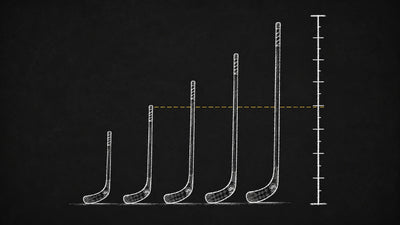
The flex describes how much a stick bends when you apply force – during a shot, for example. The number stands for the force in pounds needed to bend the shaft by a certain distance. The lower the number, the softer the stick.
- Soft flex (20 to 55) – for kids, juniors and light players. The stick loads up with very little force.
- Medium flex (60 to 80) – the best-selling range. It fits the vast majority of adult recreational and amateur players.
- Stiff flex (85 to 105) – for heavy or very strong players with a pronounced Slapshot.
The flex of the pros: Many pros used to play above 100 flex. Today a lot of young stars reach for a much lower flex. Connor Bedard plays 70 flex, Macklin Celebrini plays 82 flex. The trend clearly points downwards – a softer stick loads up faster, and for the modern wrist shot that counts for more than raw stiffness. You can see which flex other NHL and KHL pros play in our pro stick specs overview.
Why is the right flex so important?
A flex that fits helps you get the most out of your game:
- More shot power – because the shaft actually loads up properly
- Better puck control
- Lower risk of injury from overloading
- More fun, because your stick works with you instead of against you
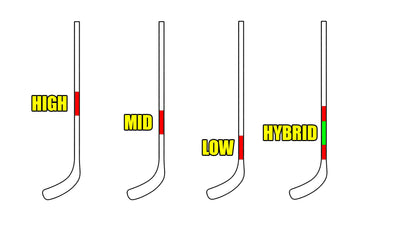
Kick points are almost as important as the flex itself. Learn more in our kick point guide.
The rule of thumb – and why it is not enough on its own
The best-known rule says: Flex = half your body weight in pounds. If you weigh 70 kg, that is around 154 pounds, which would put you at about 77 flex.
That rule is a usable starting point, but for most amateurs it comes out too stiff. The reason: it dates back to a time when the Slapshot dominated. Today the quick wrist shot is what decides games – and for that you need a stick you can actually load up. That is why our chart below sits deliberately a little below the classic rule of thumb. It matches what our customers really order.
Flex chart: guide values by body weight
Body weight is the most important factor – far more important than age or height. Height and age are listed here only for rough orientation. Look for your weight class, not your age.
| Category | Body weight | Recommended flex | Height (orientation) | Approx. age |
|---|---|---|---|---|
| Youth | up to 25 kg | 20 | up to 120 cm | 4–7 |
| Youth | 25–35 kg | 30 | 115–135 cm | 6–9 |
| Junior | 35–45 kg | 40 | 130–148 cm | 8–11 |
| Junior | 45–55 kg | 50 | 145–160 cm | 10–13 |
| Intermediate | 55–62 kg | 55 | 155–168 cm | 12–14 |
| Intermediate | 62–70 kg | 60 | 162–174 cm | 13–15 |
| Intermediate / Senior | 70–77 kg | 65 | 168–180 cm | 14–16 |
| Senior | 77–85 kg | 70–75 | 172–183 cm | 15+ |
| Senior | 85–93 kg | 80–85 | 175–188 cm | – |
| Senior | 93–100 kg | 85–90 | 180–192 cm | – |
| Senior | over 100 kg | 95–105 | 185 cm and up | – |
All values match the flex levels we actually offer: Youth 20 and 30, Junior 40 and 50, Intermediate 55 to 65, Senior 65 to 105.
The Flex Finder: click on your weight
Open up your weight class and you see right away what fits you – including the adjustment for your playing style.
I weigh up to 35 kg (child, Youth)
Flex 20 to 30. More important than any fine tuning: the stick must not be too long. A Youth stick that is too long instantly feels much stiffer, because the child grips it further down. Better one size shorter and softer – then your child learns a clean shot right from the start.
At SOYUZ: AURORA and HIT GRIT are available as youth sticks in flex 20 and 30 – as a custom stick, built in 4–6 weeks.
I weigh 35 to 55 kg (Junior)
Flex 40 to 50. At 35 to 45 kg you take the 40, at 45 to 55 kg the 50. When in doubt go for the softer option – at this age strength grows faster than weight, and a stick that is too stiff ruins your shooting technique.
At SOYUZ: the ARCANE JR is in stock in flex 40 and 50 (P28 or P29) – with you in 1–3 working days. AURORA and HIT GRIT are available as junior custom sticks.
I weigh 55 to 70 kg (Intermediate)
Flex 55 to 60. Up to 62 kg the 55, above that the 60. If you mostly play wrist shots and spend a lot of time with the puck, stay on the softer level. If you play defence with frequent Slapshots, take the 60 or 65.
At SOYUZ: in stock in flex 65: AURORA INT and STD PRO INT. As a custom stick in INT: ARCANE, AURORA, HIT GRIT and STD PRO.
I weigh 70 to 85 kg (Senior)
Flex 65 to 75. By far the biggest range – and the one where people most often buy too stiff. If you are unsure, take 70. Technical players and forwards do better with 65, strong defencemen with 75.
At SOYUZ: this is the range where we keep the most in stock – AURORA 70 / 75, HIT GRIT 75, ARCANE 75, RAPID 75 and STD PRO 75. Order today, on the ice in 1–3 working days.
I weigh 85 to 100 kg (Senior)
Flex 80 to 90. From here on the stiffer level really pays off, because you can also load up the shaft. Still, pay attention to how you shoot: if you rarely take Slapshots, you are better served with 80 than with 90.
At SOYUZ: in stock in flex 85: AURORA, HIT GRIT, ARCANE and STD PRO. All models are available as custom sticks up to 90 (AURORA), 95 (STD PRO) or 105.
I weigh over 100 kg (Senior)
Flex 95 to 105. The stiff range. Check the length especially carefully here: if you cut your stick down, you quickly end up with an effective flex beyond 110 – and even for heavy players that is often too much.
At SOYUZ: flex 95 to 105 is available as a custom stick on ARCANE, RAPID, HIT GRIT, MASTER FRST and CLASSIC SPR. Order the length with it, then you never have to cut.
Which flex values does SOYUZ actually offer – and what is in stock right now?
A flex chart is not much use if you cannot buy the value afterwards. So here is the honest overview of our seven models: which flex range, which sizes, and what you get without waiting. Custom sticks are built in 4–6 weeks, stock sticks reach you in 1–3 working days (EU 3–5) – and shipping to Switzerland and the EU is free on every stick.
| Model | Kick point | Flex | Sizes | In stock now |
|---|---|---|---|---|
| SOYUZ ARCANE comparable to Bauer Vapor Flylite · CCM Ribcor Trigger | Ultra-low | 40–105 | SR · INT · JR | SR 75 / 85 · JR 40 / 50 |
| SOYUZ RAPID comparable to Bauer Vapor Flylite · CCM Ribcor Trigger | Ultra-low | 65–105 | SR | SR 75 |
| SOYUZ AURORA comparable to Bauer Vapor Flylite · CCM Ribcor Trigger | Low | 20–90 | SR · INT · JR · YHT | SR 70 / 75 / 85 · INT 65 |
| SOYUZ STD PRO | Low | 65–95 | SR · INT | SR 75 / 85 · INT 65 |
| SOYUZ HIT GRIT comparable to CCM JetSpeed · Bauer Pulse | Hybrid | 20–105 | SR · INT · JR · YHT | SR 75 / 85 |
| SOYUZ MASTER FRST comparable to CCM Tacks | Mid | 65–105 | SR | custom only |
| SOYUZ CLASSIC SPR comparable to Bauer Nexus | High | 65–105 | SR | custom only |
Playing Bauer or CCM today? Then take the same flex number at SOYUZ and look for the model with the same kick point in the “comparable to” column. Not sure which model suits you? The Stick Finder asks you five questions and suggests one.
👉 See all SOYUZ models in the line-up
👉 What is in stock right now
The rule almost everyone misses: cutting makes it stiffer
This is the most important point in this whole article – and it is missing from almost every flex chart online.
The printed flex number only applies at full length. As soon as you cut the stick down at the top, it gets stiffer. As a guide value: for every 2.5 cm you cut off, the effective flex rises by roughly 3 to 5 points.
An example: you buy a 75 flex and cut 5 cm off because it is too long for you. That means you are effectively playing a stick of around 85 flex – two levels stiffer than you actually wanted. This is exactly why so many players are out there with a stick that simply refuses to load up.
The reverse is also true: an extension makes the stick softer.
The advantage of a custom stick: you specify the length directly with your order and do not have to cut anything at all. That way the flex number really is accurate – and you get exactly the feel you selected.
How to cut correctly, when an extension is the better option and how to convert the change in flex – step by step in our guide to cutting and extending.
What role does your position play?
The way you play counts too. Take the chart as your starting point and shift yourself by one level:
- Modern forward or technical player with a quick release and a lot of stickhandling → one level softer
- Defenceman or power player with Slapshots and one-timers → one level stiffer
- Beginner, regardless of weight → one level softer, that makes it easier to build up your shooting technique
Example: Luca is 13, weighs 48 kg and plays forward. The chart gives him flex 50 – ideal for technique and quick wrist shots.
Example: Enzo is 17, weighs 79 kg and has a powerful Slapshot as a defenceman. The chart says 70 to 75, and because of his position it becomes 75.
Read more about which kick point and which SOYUZ model suit defensemen, centers and wingers in our position guide.
Common flex mistakes – and how to avoid them
❌ Taking over a teammate's stick even though weight and height do not match
❌ A child playing with a senior stick – too stiff and too long
❌ Never adjusting the flex to a changed body weight
❌ Cutting the stick down without factoring in the change in flex
❌ Choosing by age instead of by weight
✅ Better: find your weight class in the chart, take your position into account, and order the right length straight away instead of cutting it later.
Explained in 30 seconds – our flex video
📽️ Perfect for parents or newcomers who want a quick overview.
Frequently asked questions about flex
What happens if my flex is too stiff?
The shaft barely bends during the shot. That means the catapult effect is missing, your shot gets slower instead of faster, and you have to use more body strength. Too stiff is the more common of the two mistakes.
What happens if my flex is too soft?
The stick bends too much, the puck goes high and inaccurate. On top of that, a clearly too soft stick breaks sooner. For beginners a slightly too soft stick is still more pleasant than one that is too stiff.
Where do I find the flex on my stick?
The number is printed on the shaft, usually in the upper third, near the blade designation. With a custom stick you know the value anyway: you ordered it yourself.
Do I have to adjust the flex if I gain weight?
For adults only at a difference of about 8 to 10 kg. For kids and juniors, on the other hand, with practically every growth spurt – which is why it is worth rechecking their weight class every season.
I am switching from Bauer or CCM to SOYUZ – which flex do I take?
The same as before. The flex scale is comparable across brands; the differences you feel when switching come from the kick point and the shaft profile, not from the flex number. Just check whether you had cut your old stick – then you were effectively playing stiffer than what was printed on it.
How fast can I get a stick in my flex?
Stock sticks (AURORA, HIT GRIT, ARCANE, RAPID, STD PRO in the common flex values) reach you in 1–3 working days in Switzerland, 3–5 working days in the EU. A custom stick with exactly your flex, length and curve is built in 4–6 weeks.
Conclusion: the right flex brings you more fun and more success
Child or adult, beginner or veteran – your stick should suit you. Go by your body weight, shift yourself one level depending on your position, and factor in any cutting. That puts you much closer to your optimal flex than any age guideline ever will.
If you are not sure, write to us – we will advise you personally before you order.
👉 Stick Finder: 5 questions to the right model
👉 In stock – with you in 1–3 working days
👉 Configure a custom stick with your flex
Further guides & configuration
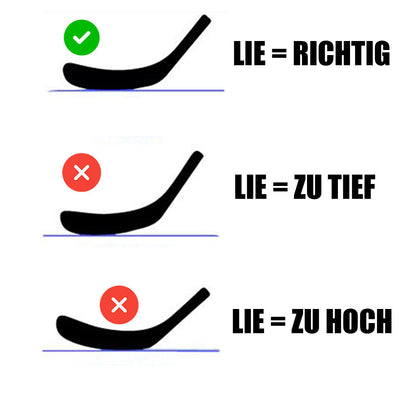
This article is part of our big hockey stick guide. Also relevant: the size chart by height, weight and age, the size guide for kids and juniors, which kick points exist, how to cut or extend correctly, why two sticks of the same weight feel different, how to choose the right weight and what the lie angle means.

 SOYUZ STD PRO SR
 SOYUZ AURORA
 SOYUZ STD PRO INT
 Ice hockey stick SR 425g