Hockey Stick Sizes for Kids & Juniors: The Complete Guide
Your child is starting the new season and you are standing in the shop (or in our store) wondering: which stick size is the right one? Youth, Junior, Intermediate – the terms get confusing fast, and a poorly chosen stick holds back development more than most people think. Here is the complete guide for parents – with a size chart, rules of thumb and the most common mistakes.
Why the right size matters so much
A stick that is too long or too stiff is the most common equipment mistake in kids’ hockey. The consequences: the puck is handled far away from the body (worse stickhandling), the child cannot flex the shaft when shooting (no flex = no shot) and gets used to an upright, stiff posture. With the right stick, the opposite happens: technique develops almost by itself.
Youth, Junior, Intermediate – what does it mean?
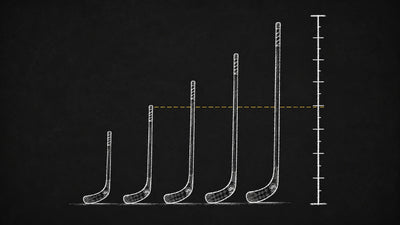
The size classes differ not only in length but also in flex (how much the shaft bends) and shaft diameter – kids’ hands need a slimmer shaft for a proper grip.
| Class | Age (approx.) | Height | Flex range |
|---|---|---|---|
| Youth (YTH) | 4–7 years | approx. 95–125 cm | 20–30 |
| Junior (JR) | 7–13 years | approx. 120–155 cm | 40–50 |
| Intermediate (INT) | 12–15 years | approx. 150–170 cm | 55–70 |
| Senior (SR) | from approx. 15 years | from approx. 165 cm | 75+ |
Age and height are guidelines – height always beats age. A tall 11-year-old may be better off with an Intermediate than a Junior.
The length rule of thumb
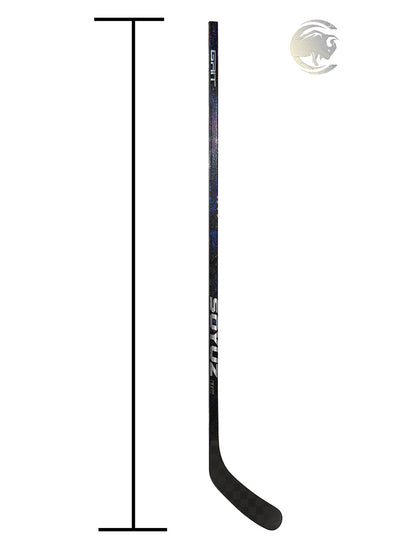
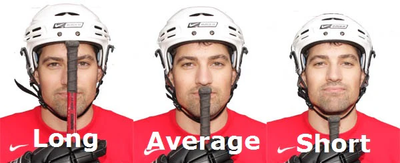
Have your child stand up straight, stick vertical in front of the body, blade on the floor:
- Without skates: the top of the shaft should end somewhere between nose and chin.
- With skates: the top of the shaft should be at about chin height.
More offensive players (stickhandling, dangles) tend towards the shorter end of that range, defensemen who value reach towards the longer end.

And which flex?
The simplest rule of thumb: flex roughly equal to body weight in kilograms – a 35 kg child plays around 30–40 flex. When in doubt, always go softer: a shaft that is slightly too soft is a small problem, one that is too stiff prevents the child from ever learning to shoot. More in our detailed flex guide.
Cutting the stick – yes or no?
Cutting is perfectly fine – within reason. Important to know: every cut makes the shaft stiffer (about 2–3 flex points per ~2.5 cm). Cut a junior stick by 10 cm and a 40 flex quickly becomes a 50 – and suddenly the flex no longer fits. As a guideline: do not cut more than ~5 cm, otherwise choose the appropriate size class instead.

The 3 most common buying mistakes
- Buying “to grow into”. A stick that will fit in a year holds back development for exactly that year. Sticks are consumables – buy the size that fits now.
- Ignoring flex. The most common mistake of all – see above.
- Cutting down a senior stick. Too stiff, too thick, too heavy. Even if it seems cheaper: for kids this is the worst option.
Junior and youth sticks at ABSHockey
We offer custom sticks in junior and youth sizes too – including name and number on the shaft (pure gold in the kids’ locker room). Most popular for kids and juniors: the lightweight SOYUZ AURORA (JR/YTH) and the robust SOYUZ HIT GRIT (all sizes). For the blade, our Curve Guide helps – for beginners we recommend a balanced mid curve.
FAQ
My child is between two size classes – which one should I pick?
When in doubt, the smaller class. Control and being able to use the flex matter more than reach.
How often does a child need a new stick?
Check about once a year during growth spurts: does the length still fit (rule of thumb above)? Is the flex still below body weight in kg? If neither fits any more, it is time.
Does the adult rule apply to kids as well?
Yes, the length rule of thumb is the same – you can find the complete guide for adults here.

 SOYUZ ARCANE JR
 SOYUZ HIT GRIT JR
 Ice hockey stick YHT
 ABSHockey Flash 1.0