Hockey Sticks for Kids: The Parents' Guide
Hockey Sticks for Kids: The Parents' Guide
The first stick of their own is a big moment for your child – and for you as a parent it often comes with a string of questions nobody in the shop really answers. Youth or Junior? Which flex? And why is the stick at the club different from the one in the sports shop?
This guide walks you through the four decisions, in the order they actually come up.
The four decisions in the right order
Stick to this sequence – then almost nothing can go wrong:
| Step | Decision | How important? |
|---|---|---|
| 1 | Side – left-handed or right-handed shot | Can't be fixed later. Settle this first. |
| 2 | Category and length – YTH, JR or INT | The key sizing decision |
| 3 | Flex – by weight, not by age | Decides whether your child learns to shoot |
| 4 | Blade – the curve | Barely matters at the start |
Step 1: Left-handed or right-handed shot
This is the one decision you can't correct afterwards – a stick can't be flipped around. And be careful: the writing hand tells you almost nothing. Plenty of right-handers play as a left-handed shot, because the more skilful hand sits on top at the butt end and does the fine work there.
The easiest test at home: hand your child a broom and let them sweep the floor without thinking about it. If the right hand is on top, they're a left-handed shot.
👉 In detail, with three tests: Left-handed or right-handed shot? How to find your shooting hand
Step 2: Which category and which length?
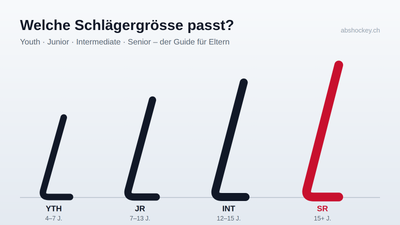
Kids' sticks come in three categories. They differ not only in length but also in shaft circumference – a Youth shaft is thinner so that small hands can actually grip it.
| Category | Age approx. | Height | Shaft |
|---|---|---|---|
| Youth (YHT) | 4–8 | up to approx. 135 cm | thin, very light |
| Junior (JR) | 8–13 | approx. 130–160 cm | narrow |
| Intermediate (INT) | 12–16 | approx. 155–175 cm | almost Senior |
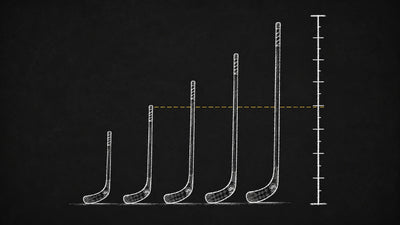
How to measure properly: your child stands up straight, without skates, and holds the stick vertically in front of them with the toe of the blade on the floor. The top end should sit between chin and nose. On skates it then reaches roughly to the chin.

👉 More on this: What is the right size for an ice hockey stick?
Step 3: Flex – by weight, not by age
This is where people get it wrong most often. Flex describes how much the shaft bends. If it's too stiff for your child, nothing bends at all – and without that bend there is no catapult effect. Your child then learns to shoot with pure arm strength, and that is exactly the technique that takes a lot of work to unlearn later.
Body weight is what counts, not age:
| Child's weight | Flex | Category |
|---|---|---|
| up to 25 kg | 20 | Youth |
| 25–35 kg | 30 | Youth |
| 35–45 kg | 40 | Junior |
| 45–55 kg | 50 | Junior |
| 55–62 kg | 55 | Intermediate |
| 62–70 kg | 60 | Intermediate |
When in doubt, always take the softer step. At this age strength grows faster than weight – a slightly too soft stick never hurts, a stick that's too stiff does.
👉 Full table and flex finder: Which flex suits you?
Step 4: The blade
Honest answer: at the start it hardly matters. A child who is just learning to shoot barely notices the difference between two curves. Go for a versatile standard curve like P28 or P92 – you can play everything with those. Only from around the age of twelve, when a playing style starts to show, is the fine selection worth it.
The most expensive parent mistake: buying to grow into
The thinking is completely understandable – kids grow fast, sticks cost money. Even so, it's the mistake that costs the most, for two reasons.
First, a stick that's too long automatically plays stiffer. Your child grips it further down, and that noticeably raises the effective flex. A 40 flex that's too long behaves like a 50 or 55.
Second, it ruins the technique. With a stick that's too long your child stands more upright, can't get the puck cleanly in front of the body and learns a ragged shot. That habit stays around longer than the stick does.
The better solution: buy the right size and extend it later, as your child grows. A carbon extension adds 10 or 15 cm to the top of the shaft and costs a fraction of a new stick.
When is a new stick worth it?
Not automatically every season. Check these three points instead:
- The length: if the stick no longer reaches the chin when your child is standing, it's time – often an extension is enough to start with.
- The weight: if your child has jumped a flex step, the stick should follow. With kids it's worth checking every season.
- The category change: moving from Youth to Junior or from Junior to Intermediate also changes the shaft circumference. Extending no longer helps here.
What does it cost – and what makes sense?
With kids, the most expensive stick is rarely the best one. What matters more is that size and flex are right. A stick that fits, at 90 francs, does far more for your child than a 300-franc pro model that's two sizes too big.
On top of that: kids' sticks break – from skate blades, boards and checks along the boards. That's normal and not a material defect. That's exactly why, with juniors, we go for sensible value for money instead of prestige.
Checklist before you buy
✅ Side settled – with the broom test, not via the writing hand
✅ Category chosen to match height
✅ Length measured: standing, between chin and nose
✅ Flex determined by current weight
✅ When in doubt, one step softer
✅ Not bought to grow into – better to extend later
❌ Don't go by age from a table
❌ Don't hand down the older sibling's stick if size and flex don't fit
❌ Don't use an adult stick broken off at the top as a kids' stick
Not sure? Just ask
If you're torn between two sizes or flex steps, just send us your child's age, height and weight. We'll tell you what fits – and if an extension is the better solution than a new stick, we'll say that too.
Further guides
This article is part of our big ice hockey stick guide. Also worth reading: find your shooting hand, choose the right flex and cut or extend a stick.

 SOYUZ HIT GRIT JR
 SOYUZ ARCANE JR
 Ice hockey stick YHT
 ABSHockey Mini Hockey Stick