How to Choose a Hockey Stick: 7 Facts That Actually Matter (2026)
Last updated: 5 November 2026
Most bad stick purchases don't happen because someone picks the "wrong" model. They happen because the order is wrong: first you pick the best-looking design, then some flex, and at home you cut ten centimetres off the stick – which suddenly makes it two flex steps stiffer. This guide flips that around. Seven decisions, in the order you should make them. With the rules of thumb that work for our customers, and with what people actually ordered over the last 90 days.
Short answer: the 7 facts in the right order
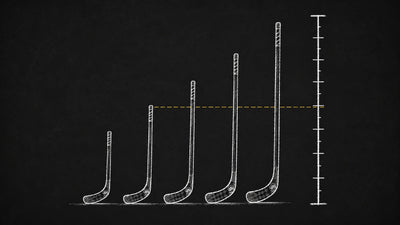
- Category (YTH, JR, INT, SR) – decided by your height, not your age.
- Shooting side – LH means: blade on the left, right hand on top.
- Length – without skates, between chin and nose.
- Flex – body weight in kg ≈ flex. Cutting makes it stiffer.
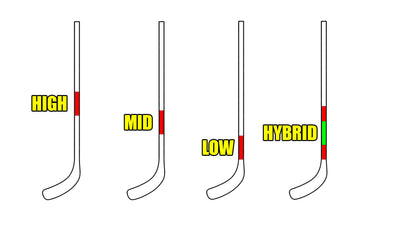
- Kick point – low for quick wrist shots, mid/high for slap shots.
- Curve – when in doubt, a mid curve like P29/P92 or the P28.
- Budget & model – only once 1 to 6 are settled. Not the other way round.
Not in the mood to read? The Stick Finder asks you the essentials in one minute.
What our orders show
Before the rules, a look at real numbers. We sell SOYUZ sticks only, in stock and custom. From our recent orders:
- Senior dominates: of 230 custom sticks in the last 90 days, 194 were senior (84 %), 23 intermediate, 12 junior and 1 youth.
- Left is the standard: 82 % of in-stock senior sticks shipped as LH. If you shoot left, you're clearly in the majority here.
- Flex 75 is the sweet spot: 64 % of in-stock senior sticks were flex 75, 19 % flex 85, 12 % flex 70. (We don't stock every flex – but the distribution still shows clearly where most players land.)
- Low kick leads: 42 % low kick, 27 % hybrid, 21 % ultra-low, 7 % mid, 2 % high (287 SOYUZ player sticks, end of July to end of October 2026).
- Two curves make up the majority: P28 (31 %) and P29 (27 %), followed by P86 (13 %) and P92 (8 %) – 105 player sticks between mid-October and early November.
That doesn't mean you have to do the same. But if you're unsure about a decision, going with the majority is rarely completely wrong.
1. Category: YTH, JR, INT or SR
The category determines length, flex range and – something many forget – shaft thickness. A junior shaft is thinner so a child's hand can actually wrap around it. An adult with a junior shaft, on the other hand, has too little in his hands.
| Category | Height (guide) | Flex options |
|---|---|---|
| Youth (YTH) | up to approx. 140 cm | 10, 20, 30 |
| Junior (JR) | approx. 140–162 cm | 40, 50 |
| Intermediate (INT) | approx. 158–175 cm | 55, 60, 65 |
| Senior (SR) | from approx. 170 cm | 65 to 105, in steps of 5 |
The ranges overlap on purpose. Rule of thumb: height decides the category, weight decides the flex. Below roughly 60 kg, intermediate is usually a better choice than a soft senior stick. The full table with lengths in inches and centimetres is in our hockey stick size chart; for kids, see the parents' guide.
2. Shooting side: left or right?
An LH stick (left-handed) has the blade on the left side of your body, with your right hand on top of the shaft. An RH stick is the opposite. The hand you write with says little – many right-handers shoot left. The quickest test: grab a broom and sweep something across the floor without thinking. The hand that automatically goes on top is your top hand on the stick.
If you play floorball, you'll usually take the same side as there. All the details and special cases are in our guide Left or right-handed hockey stick?
3. Length: between chin and nose
Stand in sneakers, stick upright in front of you, toe of the blade on the floor. The top end belongs between your chin and your nose. On skates that's roughly chin height.
- Closer to the chin: more control, lower stance, quicker stickhandling. Typical for forwards.
- Closer to the nose: more reach and more leverage on slap shots. Typical for defencemen.
Senior sticks come long from the factory (the ARCANE, for example, is 1,690 mm) – almost everyone cuts them. That's not a problem, as long as you keep point 4 in mind.
4. Flex: your weight in kilograms
Our rule: body weight in kg ≈ flex. At 78 kg you start at flex 75 or 80. The American rule (half your body weight in pounds) gets you to around flex 85 at 78 kg – too stiff for the vast majority of amateur players. A stick you can't load doesn't shoot harder, it shoots worse.
- Lots of wrist shots, forwards, beginners: rather one step (5 points) softer.
- Defencemen with lots of slap shots: rather one step stiffer.
- More than one step away from the rule: better not.
The mistake almost everyone makes: cutting makes the stick stiffer, roughly 3 to 5 points per 2.5 cm (1 inch). Cut a 75 flex by 5 cm and you're effectively playing around flex 85. If you know you'll need to cut a lot, choose a flex one step lower from the start – or use an extension if you've cut too much. More in the flex guide.
5. Kick point: where the stick bends
The kick point is where the shaft bends the most when you shoot. The lower it is, the faster the stick loads – ideal for wrist shots and snap shots. The higher it is, the more energy you get from long wind-ups and slap shots.
| Kick point | For whom | SOYUZ models | Closest comparison |
|---|---|---|---|
| Ultra-low | Quick release, lots of puck work | ARCANE, RAPID | No 1:1 equivalent – closest are Bauer Vapor Flylite, CCM Ribcor Trigger |
| Low | Forwards, all-rounders, wrist shots | AURORA, STD PRO | Bauer Vapor, CCM Ribcor Trigger |
| Hybrid | All-rounders, centres | HIT GRIT | CCM Jetspeed |
| Mid | Powerful shooters, defencemen | MASTER FRST | CCM Tacks |
| High | Slap shots, long wind-up | CLASSIC SPR | Bauer Nexus |

If you've played a Bauer or CCM stick so far and were happy with it: stick with the same kick point. Which SOYUZ model matches which brand model is shown on our SOYUZ vs Bauer, CCM & co. comparison page. The full theory is in the kick point guide.
6. Curve: the blade makes the shot
Curves are what people argue about most online – and it's the decision where beginners overdo it most often. An extreme toe hook looks great in highlight clips, but it makes backhands, receiving passes and flat passes harder.
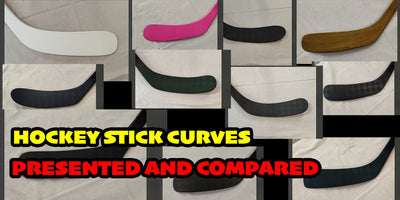
- Mid curve (P29 / P92): the all-rounder. Curve in the middle, slightly open. According to our CAD measurements, P29 and P92 are practically the same basic shape. If you don't know what you want: start here.
- Toe curve (P28): curve further towards the toe, shorter blade, the puck comes off quickly and high. Ideal for snipers and tight stickhandling – but more demanding on backhands and passes.
- Flatter blades (P88, P86): more control on passes and backhands, less "automatic" lift.

The quickest way to see the difference is the Curve Lab: P28 vs P29 in 3D. The curve guide gives you the full overview of all shapes, and P28 vs P29 compares the two favourites head to head. And if your blade touches the ice with the heel or the toe when stickhandling, your issue is the lie – not the curve.
7. Budget and model: only now
Only once category, shooting side, length, flex, kick point and curve are settled is it worth looking at the price tag. The order matters: a 300-franc stick in the wrong flex plays worse than a 190-franc stick in the right one.
All SOYUZ player sticks are 100 % carbon. Senior prices:
| Model | Kick point | Price SR | What stands out |
|---|---|---|---|
| STD PRO | Low | CHF 187 | 400 g, flexed 12,000 times in the test lab without breaking – the tough one |
| AURORA | Low | CHF 204 | 365 g, available in all sizes from YTH to SR |
| MASTER FRST | Mid | CHF 235 | 380 g, for powerful shooters |
| CLASSIC SPR | High | CHF 235 | 375 g, the only model built in the Nexus style |
| HIT GRIT | Hybrid | CHF 245 | 375 g, for anyone used to a Jetspeed |
| ARCANE | Ultra-low | CHF 268 | 365 g, slim S-shaft with AEROX taper |
| RAPID | Ultra-low | CHF 285 | 365 g, D-shaft, best results in lab testing – the hand feel takes some getting used to |

In stock or custom? In stock means: order by 2 pm and in Switzerland it's normally with you the next day. P28 and P29 are in stock in all seven senior models. Custom means: your flex, your curve, your lie, your name on the shaft – delivery time 4 to 6 weeks, and because the stick is built for you, no returns. Both come with a 30-day warranty from receipt, and shipping to Switzerland and the EU is free.
Which stick fits which type of player?
| You are … | Kick point | Flex | Curve to start with |
|---|---|---|---|
| Quick forward, wrist shooter | Ultra-low / low (ARCANE, RAPID, AURORA) | Weight in kg, rather −5 | P28 or P29 |
| Centre / all-rounder | Low or hybrid (AURORA, HIT GRIT) | Weight in kg | P29 / P92 |
| Defenceman with a slap shot | Mid / high (MASTER FRST, CLASSIC SPR) | Weight in kg, rather +5 | P29 / P92 or P88 |
| Plays a lot, breaks sticks often | Low (STD PRO) | Weight in kg | P29 or P28 |
In detail by position: defence, centre & wing. And if you want to know what the pros use: our pro stick specs.
Three things that matter less than you think
- Weight: you feel a few grams less than the balance. A well-balanced 400 g stick doesn't feel sluggish.
- The price itself: above a certain level you mostly pay for weight and marketing. Why sticks are so expensive in the first place is covered in the truth about expensive hockey sticks.
- What your favourite player uses: NHL pros often play custom blades and flexes that fit their body – not yours.
We've collected the typical buying pitfalls in 5 common mistakes when buying a hockey stick. Goalies will find the right paddle length in our goalie stick guide.
Your next step
Got your seven answers? Then build your stick in the configurator – or check whether your combination is available in stock right away. Still unsure? The Stick Finder makes a suggestion in one minute.
FAQ
Which hockey stick is right for me as a beginner?
For beginners, length and flex matter more than the model. Choose a flex one step softer than your body weight in kg, don't cut too much, and start with a mid curve like the P29 or P92. A low-kick stick loads easily and forgives technique mistakes.
How do I find the right flex?
Body weight in kg ≈ flex. Forwards and beginners one step softer, defencemen with lots of slap shots one step stiffer. Important: every 2.5 cm you cut makes the stick 3 to 5 points stiffer.
How long should my hockey stick be?
Without skates, the top end should reach between your chin and nose; on skates, roughly to your chin. Shorter gives control, longer gives reach.
Am I a left or right shot?
LH means blade on the left, right hand on top. The hand you write with says little. Test it with a broom: the hand that automatically goes on top is your top hand. 82 % of our in-stock senior sticks ship as LH.
Senior or intermediate?
Height and weight decide. Below roughly 60 kg or under about 170 cm, intermediate is usually the better choice: thinner shaft, flex 55 to 65.
Is an expensive stick worth it?
Only if length, flex, kick point and curve are already right. A cheaper stick with the right specs gives you more than a top model with the wrong ones.
Further guides
- The big hockey stick guide
- The best hockey stick 2026/27
- Hockey stick size chart
- Which flex is right for you?
- Kick points explained
- Hockey blade curve guide 2026
- Why do hockey sticks break?
Data basis: ABSHockey orders (SOYUZ player sticks), as of 3 November 2026. Prices in CHF, senior, as of November 2026.


 SOYUZ STD PRO SR
 SOYUZ AURORA
 SOYUZ ARCANE
 ABSH NSC