P92M, P28M & Max Blades Measured: How Much Taller Are They Really – and Who Should Switch?
Last updated: 27 October 2026 · by Andri Farrer
P92 or P92M? P28 or P28M? "Max" sounds like more – more blade, more control, more pro. We wanted to know how much more it really is, so we measured the Max blades in SOYUZ's CAD data. The result is more interesting than expected: not every Max blade is simply the regular blade made taller. And one is barely taller than the original.
The short answer
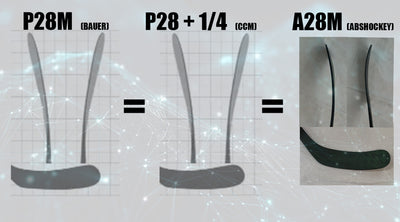
What is a Max blade? The same curve with extra material along the top edge of the blade. Bauer calls it "M" (P92M), CCM "+ 1/4" (P29 + 1/4), Warrior "Max" (W03 Max).
How much taller? In the SOYUZ CAD data: P88 +1/4 plus 4.8 mm, P28M plus 4.1 mm, P92M just plus 0.8 mm. Not a single blade adds the full 6.35 mm that "+1/4 inch" suggests.
Who is it for? Centers who take lots of faceoffs, net-front players, defensemen who block and receive a lot of pucks. Less so for danglers who pull the puck around on the toe.
Which SOYUZ? Our first choice is the P29 +1/4 (custom from 1 stick). For toe shooters the P28M (custom from 1 stick, partly in stock). The P92M is available from 1 stick, but only on the CLASSIC SPR.
What is a Max blade, anyway?
In its official blade pattern guide, Bauer describes the P92M as a P92 curve with additional material on the top of the blade – designed to help with puck control on bad ice, puck battles, tipping pucks and faceoffs. According to Bauer, curve, face and lie are identical to the P92 (both lie 6). In other words: a Max blade doesn't promise a new curve, it promises more surface.
The confusion comes from the names. Every brand labels the same idea differently:
| Base curve | Bauer Max version | CCM | Warrior | SOYUZ |
|---|---|---|---|---|
| P92 / P29 | P92M (P92 Max) | P29 + 1/4 | W03 Max | P29 +1/4 · P92M · P29M |
| P28 | P28M (P28 Max) | P28 + 1/4 | W28 Max | P28M · P28 +1/4 |
| P88 | – | – | – | P88 +1/4 |
Equivalents according to our Curve Lab and our own matching. Bauer's current pattern guide only lists the P92M as a Max blade. There is no CCM version of the P88 – CCM's counterpart to the P88 is the P40, and a "P40 Max" doesn't exist.
Whether "+1/4" and "M" from CCM and Bauer are really the same thing, we already measured by hand – the verdict is in our article P29 + 1/4, P92M & P28M explained. This article answers a different question: what does a Max blade change compared with the regular blade?
Measured: regular blade vs. Max blade
The values come from the CAD files SOYUZ supplied for every blade – the same numbers you see in the 3D Curve Lab. We always compare the same blade type: P92 and P92M are both the CLASSIC SPR blade, P28/P28M and P88/P88 +1/4 the standard blade used on the other models.
| Blade | Length mm | Height mm | Curve depth mm | Face mid | Face toe |
|---|---|---|---|---|---|
| P92 | 287.7 | 74.8 | 11.5 | 6.2° | 10.9° |
| P92M | 288.6 | 75.6 | 10.2 | 5.0° | 10.8° |
| P28 | 273.1 | 74.1 | 11.2 | 5.6° | 11.6° |
| P28M | 277.4 | 78.2 | 14.6 | 5.7° | 12.1° |
| P88 | 276.3 | 72.4 | 13.3 | 2.0° | 4.9° |
| P88 +1/4 | 276.2 | 77.2 | 14.5 | 2.0° | 4.5° |
Curve depth = how deeply the blade is curved from heel to toe. Face = how open the blade face is, in degrees; the higher, the more open (more lift). We deliberately left out the lie – more on that in our lie guide.

Overlay P92M and P92 in 3D →
Compare P28M and P28 in 3D →
Compare P88 +1/4 and P88 in 3D →
What the numbers tell us
1. "+1/4" is not a measurement. A quarter inch is 6.35 mm. None of the three Max blades adds that much. The P88 +1/4 comes closest with 4.8 mm, the P28M grows by 4.1 mm. With just 0.8 mm extra, the P92M is practically as tall as the P92. If you order a P92M purely for the height, the CAD data says you get almost nothing for it.
2. Max doesn't always mean "same blade, just taller". The P88 +1/4 is the textbook case: same length, same face angle, clearly more height. The P28M, on the other hand, is also a good 4 mm longer and curved deeper (14.6 vs. 11.2 mm) at almost the same face angle. So it doesn't just feel bigger, it also cups the puck a bit more. The P92M goes the other way: slightly flatter and more closed in the middle than the P92.
3. The face angle stays almost the same. That's the good news: how much the blade lifts the puck barely changes on the P28M and P88 +1/4. A Max blade doesn't make your shot higher or flatter – it gives you more surface.
My take: a Max blade isn't an upgrade for everyone, it's a tool for specific situations. If you take faceoffs every night and tip pucks in front of the net, you'll benefit. If you dangle in the slot, you don't need it.
Pros and cons of a Max blade
| Pros | Cons |
|---|---|
| More surface on faceoffs – the puck slides over the blade less often | More material in the blade: the stick becomes slightly more blade-heavy |
| Easier tips and pucks out of the air | Toe drags and tight moves feel a bit clunkier |
| Bouncing pucks on bad ice stay on the blade more often | Looks unusual; the first few practices feel "big" |
| Safer pass reception and blocking along the boards | On the P92M the height gain is very small according to the CAD data |
About weight: more material inevitably means a few grams more at the bottom. We haven't weighed this separately for SOYUZ, so we won't give you a number here. How a heavier blade end changes the feel is explained in our article on balance and swing weight.
Who plays a Max blade?
Max blades are common among pros. According to prostockhockeysticks.com, Elias Pettersson and Matthew Tkachuk both use a slightly modified version of the P92M. That's why you'll also find the SOYUZ P29 +1/4 under the name Tkachuk in our Curve Lab. As always: pros play pro stock blades that can differ from the retail version – what's behind those specs is explained in our article on dressed sticks and pro stock specs.
And at ABSHockey? Of 270 SOYUZ player sticks ordered between 22 July and 19 October 2026, 13% had a Max blade – 7% P29M and 6% P28M. One in eight customers wants more blade. That's not a niche.
Are you a Max player? Quick self-check
| If you … | then … |
|---|---|
| are a center and take lots of faceoffs | Max is worth it |
| play in front of the net, tip pucks and hunt rebounds | Max is worth it |
| are a defenseman receiving lots of hard passes | Max is worth considering |
| are a winger who mostly shoots in stride | a regular blade is fine |
| love to dangle and carry the puck on the toe | stick with the regular blade |
| have been using a Bauer P92M or CCM P29 + 1/4 | take the P29 +1/4 |
| have been using a Bauer P28M or CCM P28 + 1/4 | take the P28M |
Not sure about flex, kick point and model? Our Stick Finder recommends the right SOYUZ model in five questions. And if you're torn between the base curves: P28 vs P29 – the comparison with measurements.
Which SOYUZ Max blade should you order?
| SOYUZ blade | Comparable to | How to order |
|---|---|---|
| P29 +1/4 | Bauer P92 Max · CCM P29 + 1/4 | Custom from 1 stick on all standard models, as custom in lie 6 (SOYUZ 7) |
| P28M | Bauer P28 Max · CCM P28 + 1/4 · Warrior W28 Max | Custom from 1 stick; in stock on the AURORA flex 75 (LH and RH, only a few left) |
| P92M | Bauer P92M · Warrior W03 Max | only on the CLASSIC SPR (high kick), from 1 stick – not available on any other model |
| P29M | Bauer P92 Max · CCM P29 + 1/4 · Warrior W03 Max | Pro Custom from 3 sticks |
| P88 +1/4 | no retail equivalent | Pro Custom from 3 sticks |
My recommendation, straight up: if you want a taller P92/P29, take the P29 +1/4 – you can order it from one stick on every standard model. Only go for the P92M if you want a high-kick shaft anyway. The difference between the P29 +1/4 and the P92M is minimal. Toe shooters go for the P28M – and if you're in a hurry, check the in-stock collection first to see whether your version is available.
Custom sticks take 4–6 weeks to make and can't be returned. In-stock sticks ordered by 2 pm usually reach you in Switzerland the next day.
More blade – or not?
Lay the Max blade over your current blade in the 3D Curve Lab. Then configure it with your flex, your length and your name.
Configure custom → P29 +1/4 in the Curve Lab See in-stock sticksVideo: regular vs. Max blade
FAQ about Max blades
What does the "M" in P92M or P28M mean?
"M" stands for Max: the same curve with extra material along the top edge of the blade. Bauer uses "M", CCM writes "+ 1/4", Warrior "Max".
Is the P29 + 1/4 the same as the P92M?
Practically, yes. Both are the taller version of the P92/P29 shape. At SOYUZ the difference between the P29 +1/4 and the P92M is minimal – what matters is which model you want: the P92M is available from 1 stick, but only on the CLASSIC SPR – it is not available on any other model.
How much taller is a Max blade?
It varies a lot by blade. In the SOYUZ CAD data: P88 +1/4 plus 4.8 mm, P28M plus 4.1 mm, P92M plus 0.8 mm.
Does the P92M have the same lie as the P92?
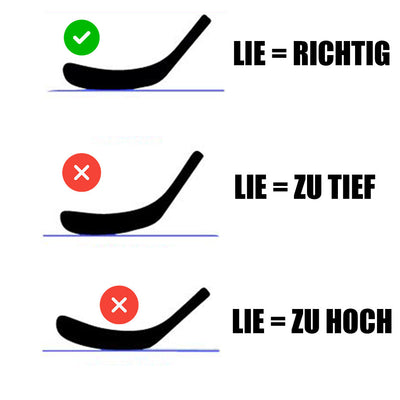
At Bauer, yes: both are listed with lie 6 in the official pattern guide. How to find your lie is explained in our lie guide.
Is a Max blade heavier?
Slightly, because there's more material in the blade. You'll notice it more as a bit of extra weight at the bottom than on a scale.
Is a Max blade a good idea for kids and juniors?
Rarely. Young players learn stickhandling and toe drags more easily with a regular blade. For kids we recommend the P29 – more in our parents' guide.
Are Max blades available in stock?
Yes, the P28M on the AURORA in flex 75, LH and RH – while the small stock lasts. All other Max blades are ordered as custom.
Related curves & configuration
- P29 + 1/4, P92M & P28M: what's behind the names?
- P29 / P92 curve measured – the mid curve in detail
- P28 curve explained – the Pastrnak curve
- P88 curve measured
- P28 vs P29: which curve suits you?
- Hockey curve guide: which blade suits you?
Next step: Lay the P28M over the P28 or the P92M over the P92 – and see for yourself how much Max is really in there.



 SOYUZ AURORA
 SOYUZ HIT GRIT
 SOYUZ ARCANE
 SOYUZ AURORA INT