Dressed Sticks & Pro Stock Specs Explained: What’s Really Behind NHL Sticks
Dressed Sticks & Pro Stock Specs Explained: What’s Really Behind NHL Sticks
Anyone who has looked more closely at NHL hockey sticks has probably come across two terms sooner or later: Dressed Sticks and Pro Stock Specs. Both topics regularly cause confusion. Many players assume NHL pros simply use the latest hockey stick available in stores. In reality, that is often not the case.
Because in pro hockey, what is written on a stick, what a stick looks like, and what is actually inside the stick can be three very different things. That is exactly why it is worth understanding this topic in more detail. If you know how to read Bauer Pro Stock Codes and CCM Pro Stock Codes, and you understand what a Dressed Stick really is, you will understand NHL sticks much better — and you will also be able to choose your own stick more consciously.
In this article, we explain in detail:
- what Dressed Sticks are
- what makes Pro Stock sticks different from regular retail sticks
- how to read Bauer Pro Stock Specs
- how to understand CCM Pro Stock Specs
- which misconceptions about NHL sticks are most common
- and what really matters when choosing the right hockey stick
If you are looking for a stick that truly fits your game, you can find a wide range of individual options in our custom sticks. You can also browse our in-stock hockey sticks for models that are available right away.
What Are Dressed Sticks?
A Dressed Stick is a hockey stick that visually looks like a current top-end model, but technically is based on a different build. Simply put: the stick carries the graphic of a new model, but internally it is often an older stick or a custom-adjusted build.
In pro hockey, this is not rare at all — it is completely normal. An NHL player can be on the ice using a stick that looks like the newest Bauer or CCM model, while in reality it may feel like an older favorite model or be based on a specific pro stock construction.
Why Do NHL Pros Use Dressed Sticks?
There are several very good reasons for this:
1. Familiarity and Trust
Pro hockey players feel even the smallest changes in their equipment. Minor differences in shaft shape, balance, kick point, length, flex, grip, or blade can change the feel of the stick on the ice. That is why many players stay with the exact setup that works for them for years.
2. Sponsorship and Brand Presentation
Pros are signed to major brands like Bauer or CCM. For the manufacturer, it is important that the current model is visible on the ice. For the player, it is important that the stick still feels familiar. The solution: the proven build gets the new graphic.
3. Performance Comes Before Marketing
At the NHL level, performance is what matters most. If a player performs better with a certain construction, that build will often stay the same. Instead of changing everything technically, only the outside design is updated. That is the core idea behind a dressed stick: new graphic, trusted internals.
Why Is This Interesting for Regular Players?
Because it exposes a very common misconception: many people assume NHL players always use the newest stick straight from the retail shelf. In reality, even the best players in the world often rely on familiar or highly customized setups. That makes one thing very clear: performance is not decided by marketing — it is decided by whether a stick actually fits the player.
What Does Pro Stock Mean in Hockey Sticks?
A Pro Stock stick is a stick produced for the professional, team, or organization level. A pro stock stick can be very similar to a retail model — but it can also differ significantly.
Pro stock usually means:
- produced for pros, teams, college programs, or organizations
- often made with custom specifications
- not necessarily identical to retail models
- marked with internal codes and identifiers
- often harder to categorize than normal store-bought sticks
The important thing to understand is this: Pro stock is not a rigid system. There are many patterns, but there are also many exceptions. Especially with NHL sticks, the same rule almost always applies: there are rules — and there are special cases.
If you want to understand the basics of flex, curve, and kick point first, we already have separate guides on these topics. You can also get a full overview of stick selection in our stick guide.
Understanding Bauer Pro Stock Specs
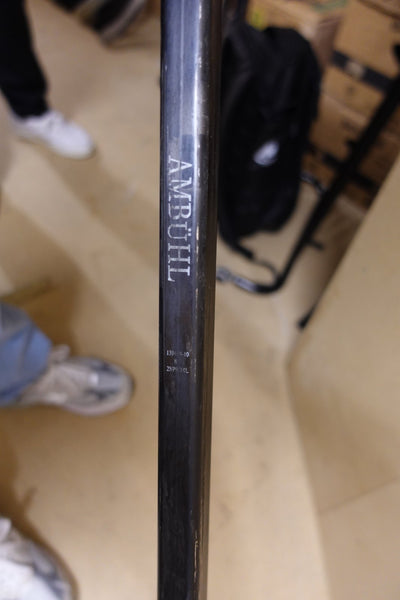
On Bauer sticks, there are often several lines of text printed on the shaft below the name bar. Depending on the stick, this information can be very revealing. Typically, Bauer Pro Stock sticks include details about:
- Player ID and version number
- Flex rating
- Build or actual model of the stick
In some cases, instead of a player ID, the stick will directly list the curve and handedness.
1. Player ID and Version Number on Bauer Sticks
On many Bauer Pro Stock sticks, the first line contains a combination such as 10922-13. The first part is typically the player-specific ID, while the second part stands for the version number.
The player ID often stays connected to the player for a very long time or even throughout their entire career. The number or identifier after the dash then indicates which version of that player’s setup the stick represents.
What matters here is this: a new version does not automatically mean a completely new stick. Even smaller changes can create a new version, for example:
- changes to the curve
- adjustments to the grip
- small flex changes
- a new graphic
- modifications to the model or build
So a player does not have to invent an entirely new setup every year. Often, new versions are created through relatively small changes.
2. Why Do Some Bauer Sticks Use Letters Instead of Numbers?
Some Bauer Pro Stock sticks show a letter after the player ID rather than a number. The principle seems to be similar, even though from the outside it is not always 100% clear why letters are used in certain cases instead of numbers. Broadly speaking, however, it still appears to be a version-related identifier within Bauer’s internal system.
3. When Bauer Lists the Curve Instead of a Player ID
Sometimes the label does not begin with a player ID, but instead with something like P88-R. This usually means:
- P88 = curve or blade pattern
- R = right-handed
This is often seen on team or college orders where not every player is entered into the system as an individual custom player. Even so, one thing is still true: many players at the pro level still use stock curves. Pro stock does not automatically mean an unusual custom pattern.
4. Flex Rating on Bauer Sticks
The next line usually shows the flex. Simply put, flex describes how much force is needed to bend the shaft. A higher value means a stiffer stick.
Typical Bauer Pro Stock flexes include:
- 55
- 60
- 65
- 67
- 70
- 77
- 82
- 87
- 95
- 102
- 107
- 112
- 117
- 122
It is noticeable that Bauer Pro Stock flexes often end in 2 or 7. In general, the pro level offers more fine increments and especially more high-flex options than the retail market.
If you want to go deeper into this topic, we also recommend our guide on choosing the right flex for your hockey stick.
5. Bauer Build Code: The Most Important Clue to What the Stick Really Is
The bottom line is especially interesting on Bauer sticks. It often tells you what the stick actually is — meaning what build or construction the stick is based on.
This is often where you can tell whether a stick truly matches the current retail model or whether it is actually a dressed stick. A stick may carry the graphic of a current release, while internally being based on an older Nexus, Supreme, or even a pro-only build.
This is the exact point where appearance and reality can separate. From the outside, the stick looks new. Technically, it may be something completely different. That is exactly why the build code on Bauer sticks is so interesting for pro stock enthusiasts.
Real-life example from our pro stock collection
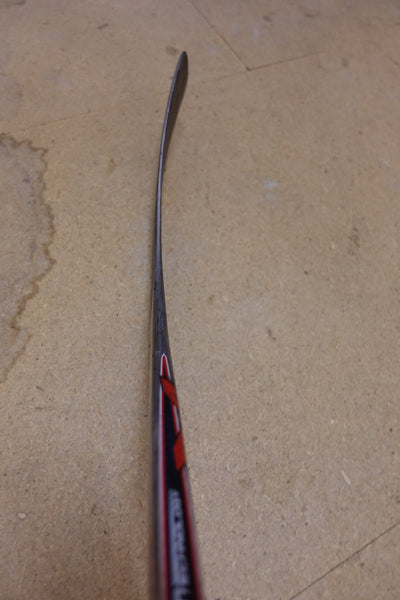
Denis Hollenstein's stick carries the graphics of a Bauer Vapor Hyperlite 2. But the shaft reads 139140-2 · 95 · 2SPRO: his player ID, flex 95 and, as the build, a Supreme 2S Pro. A textbook dressed stick.

Understanding CCM Pro Stock Specs
CCM Pro Stock sticks also have several lines of information printed below the name bar. Compared to Bauer, however, these details point to slightly different things. While Bauer often reveals quite a lot about the actual build, CCM codes mainly show:
- Factory code
- Flex rating
- Shaft geometry
- Custom ID
- Version number
Information about the curve or the exact internal construction of the stick is often not directly visible in CCM’s printed label.
1. Factory Code on CCM Sticks
On many CCM Pro Stock sticks, the first line contains a one- or two-letter factory code. This indicates the production facility where the stick was made. For collectors and pro stock enthusiasts, this can be an interesting clue.
In more recent generations, this line has sometimes been removed. So it is not unusual for modern CCM Pro Stock sticks to no longer show a clearly visible factory code.
2. Flex Rating on CCM Sticks
Just like with Bauer, the next line on CCM sticks usually shows the flex. Typical CCM Pro Stock flexes include:
- 55
- 60
- 65
- 70
- 75
- 80
- 85
- 90
- 95
- 100
- 105
- 110
- 115
- 120
One noticeable pattern is that CCM flex values often end in 0 or 5. That too can help when identifying a pro stock stick.
3. Shaft Geometry on CCM Sticks
The third line on CCM sticks often describes the shaft geometry, meaning the shape of the shaft. This is an important point because shaft shape can directly affect handling and the feel of the stick in your hands.
Typical labels include:
- Traditional (T)
- Contoured (C)
- Rounded (R)
- Ergonomic (E)
- Intermediate
Less common abbreviations or variants can include:
- K
- V
- W
- F
Why does this matter? Because shaft shape can make a major difference. Some players prefer a more square, traditional feel, while others prefer rounder or more ergonomic geometries. Once again, this shows how even small details can matter at the pro level.
4. Custom ID on CCM Sticks
Below that, you will usually find the custom ID, for example a code such as E19422. This number is generally assigned to the player or to that player’s specific setup, and it stays connected to that model.
An interesting detail is that the number can often give a rough idea of how long that setup has been in the system. A lower number often suggests that the registration happened quite a long time ago.
5. Version Number on CCM Sticks
The final line is often the version number, usually beginning with V01. This tells you which version of that specific custom build the stick represents.
If a player makes smaller changes without needing to register an entirely new build, the version can become V02, V03, or V04. These changes can include things such as:
- curve
- flex
- grip
- length
- height
If a larger model change happens, however, the version cycle often starts over again with a first version.
What Pro Stock Codes Tell You — and What They Don’t
This is exactly where the biggest misunderstandings happen. Many players hope that the codes on a pro stock stick will instantly tell them everything: the exact curve, the exact construction, the underlying model, or the true feel of the stick.
In practice, it is not quite that simple. Pro stock codes often provide very helpful hints — sometimes even very precise ones. But they do not always tell the whole story. In the pro world, there are many exceptions, individual adjustments, and special cases.
That is why one key principle applies: the codes help you interpret a stick, but they do not replace experience and overall understanding.
Pro Stock vs. Retail: What’s the Difference?
Retail Sticks
Retail sticks are the models sold regularly in stores. They are standardized, clearly named, and designed for a broad target audience. That is exactly why they are the logical and sensible choice for most players.
Pro Stock Sticks
Pro stock sticks, on the other hand, are built for a more specific purpose. They can be:
- identical to retail sticks
- slightly adjusted
- or significantly different from a retail model
A pro stock stick is therefore not automatically better. It is primarily more individualized or differently specified. Whether it is better for you depends on how well it fits your game.
The Biggest Misconception: NHL Players Do Not Simply Use the “Best” Stick
Many people assume pros automatically use the most modern and technically advanced hockey stick available. That sounds logical, but it is too simplistic. A stick is not a universal product. It is a tool that has to fit the specific player using it.
An NHL player does not use the stick that sounds most impressive on paper. They use the stick that feels best to them and allows them to perform at the highest level. That includes things like:
- shooting mechanics
- timing
- release characteristics
- grip feel
- balance
- blade behavior
- position
- physical strength
- long-term familiarity
That is why the setup of an NHL star is not automatically the best choice for an amateur player. And that is exactly why it is so important not to focus only on model names or marketing.
What You Can Learn from This as a Player
Dressed sticks and pro stock specs are not only interesting for collectors. They also reveal an important truth that matters to every hockey player:
Performance is not determined by graphics or marketing, but by how well a stick fits the player.
For you, that means very clearly:
- do not focus only on the model
- do not focus only on the brand
- do not focus only on what an NHL player supposedly uses
- instead, pay attention to your own specifications
The questions that really matter are:
- What flex fits you?
- Which curve supports your game?
- What length makes sense for you?
- What shaft shape feels right in your hands?
- Which kick point matches your shooting style?
If you choose these factors correctly for yourself, it will usually help your game much more than simply buying a popular top-end stick.
If you want to go deeper into these topics, here are our related guides:
- How to choose hockey stick flex
- How to choose a hockey stick blade
- Hockey stick kick point: which kick point should you choose?
- Stick guide
Why Individual Specs Matter So Much
Dressed sticks make one thing especially clear: individual specifications matter. If even NHL pros do not blindly move to the newest model, but instead stick closely to the setup they prefer, that tells you something important. In many cases, the right hockey stick is not simply a standard product — it is a stick that fits the personal needs of the player.
That is why factors like these matter so much:
- flex
- curve
- length
- grip
- kick point
- weight
- shaft shape
- balance
The better these specs match your playing style, the more natural and consistent your stick will feel. If you are looking for a more individualized approach, take a look at our custom hockey sticks. If you prefer models that are ready to ship, you can find them among our in-stock sticks.
Common Misconceptions About Dressed Sticks and Pro Stock Specs
“If an NHL player uses this model, it must be the exact same stick sold in stores.”
Often, it is not. That is exactly why dressed sticks exist. The graphic may be current, while the actual build is something else.
“Pro Stock automatically means better.”
Not necessarily. Pro stock mainly means more individualized or differently specified. Whether that is better for you depends on your needs.
“You can always tell everything exactly from the codes.”
No. The codes often provide valuable hints, but they do not always tell the full story.
“The stiffer the flex, the better.”
That is not true across the board. The right flex depends on your weight, technique, shooting style, and personal preferences.
“The newest model is always the best choice.”
Not even NHL players think that way. Many stay with what works for them, even if that means using an older underlying build.
Conclusion: How to Properly Understand Dressed Sticks and Pro Stock Specs
Anyone who looks more closely at NHL sticks quickly realizes that this topic is much more complex than it first appears. A hockey stick can look like the newest top-end model and still be something completely different internally. That is exactly what the world of dressed sticks is all about.
The visible codes on Bauer and CCM Pro Stock sticks provide fascinating clues — with Bauer especially revealing player ID, version, flex, and build, and CCM mainly pointing to factory code, flex, shaft geometry, custom ID, and version. These details help you better understand pro stock sticks and the logic behind NHL setups.
But the most important conclusion is a different one: it is not the logo, not the graphic, and not the model name that matter most — it is whether the stick truly fits you.
If you want help choosing the right stick or would like to learn more about our philosophy, you can find more information here:
FAQ: Common Questions About Dressed Sticks and Pro Stock Specs
What is a dressed stick?
A dressed stick is a hockey stick with the graphic of a current model, while the actual internal build may come from a different or older model.
What does pro stock mean in hockey sticks?
Pro stock refers to sticks produced for the professional, team, or custom market, often with individualized specifications.
Can you identify the real specs of a Bauer Pro Stock stick from the code?
Partially, yes. Player ID, version, flex, and often the build can usually be interpreted. But there are exceptions.
What do CCM Pro Stock codes tell you?
CCM codes usually provide clues about the factory code, flex, shaft geometry, custom ID, and version number.
Do NHL players really use the same sticks sold in stores?
Often they do not. Many NHL players use custom setups or dressed sticks that only look like current retail models.
Is a pro stock stick better than a retail stick?
Not automatically. A pro stock stick is mainly more individualized. Whether it is better depends on how well it fits your game.
Why is shaft shape so important on CCM sticks?
Shaft shape directly affects how the stick feels in your hands. Some players prefer more traditional, square shapes, while others prefer rounder or more ergonomic geometries.
What should I really pay attention to when choosing a hockey stick?
Above all, pay attention to flex, curve, length, kick point, grip feel, and how well the stick matches your playing style. Our stick guide can help you with that.
Why ABSHockey & SOYUZ
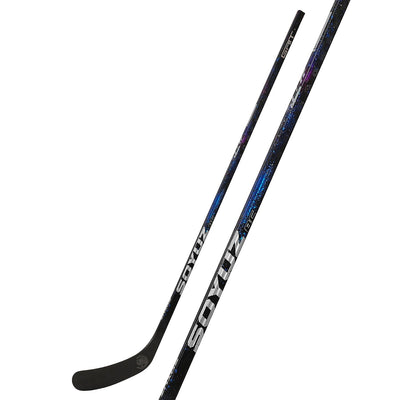
We build custom sticks on the SOYUZ platform. More on that: about the SOYUZ brand. On topic: how our custom process works and which stick is the best?.

 SOYUZ ARCANE
 SOYUZ RAPID
 SOYUZ HIT GRIT Gloves