The Datsyuk Curve: Why a Genius's Bend Was Never an Accident
The Datsyuk Curve: Why a Genius's Bend Was Never an Accident
Pavel Datsyuk was never the fastest, never the hardest hitter, never the loudest player on the ice. And yet nobody ever saw him coming — not opponents, not fans. "The Magic Man" didn't control the puck, he negotiated with it. And part of that magic lives literally in the blade — or rather, in the carbon.

What the curve actually does
A stick curve is simple at its core: it defines how the blade sits relative to the shaft and how strongly it bends. Three values matter most:
- Lie – the angle between shaft and ice. Determines how upright or low you carry the puck.
- Curve depth – how pronounced the blade's curvature is. More depth means more cupping surface for handling and saucer passes, less precision on flat shots.
- Face angle / toe curve – whether the curve sits more towards the middle (mid) or the tip (toe) of the blade.
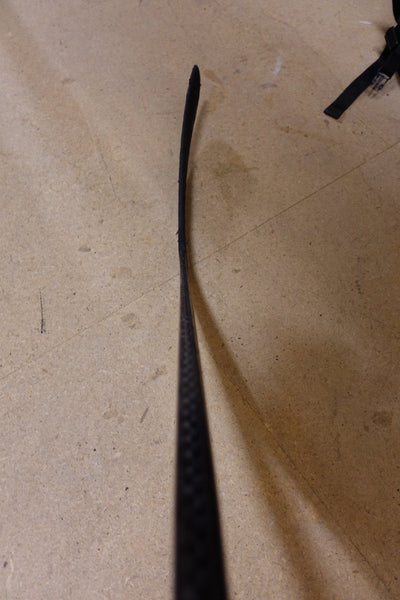
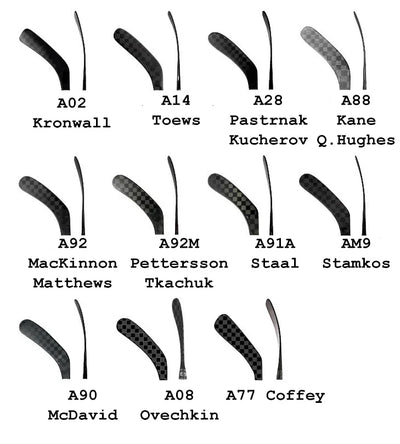
The DATSYUK curve is a mid curve with moderate depth and an open blade face. No extremes — and that was exactly the point.
Where mystique meets mechanics

While many forwards lean on extreme toe curves for explosive releases, Datsyuk went the other way with a balanced curve that let him control the puck at almost any point of the blade — toe, middle, even the heel, whenever he had to thread it through a tunnel between two defenders. An extreme curve gives you power and lift at one sweet spot. Datsyuk's curve gave him control across the entire face — exactly what you need when your game is built on deception rather than power.

That's the real trick: his curve wasn't built for the shot. It was built for stickhandling. The open blade face allows clean puck contact during toe drags and quick changes of direction, without the puck "sliding off" — which is exactly what happens with heavily curved toe blades.
Why it still matters today

Look at the modern game: most top skill players today run toe curves, because they give more pop on release and quick wrist shots. Draisaitl is the exception — his curve is strikingly moderate for his skill level, closer to Datsyuk's philosophy than to the toe-curve trend. That's what makes the comparison interesting: while the league trends toward the toe, players like Draisaitl — and Datsyuk before him — prove that a balanced curve still works at the highest level, as long as your game is built on control rather than raw shot power.
At the end of the day, a curve is just a piece of bent carbon. But for Datsyuk, it did exactly what his entire game was about: it never gave the opponent anything to read.
Related Curves & Configuration
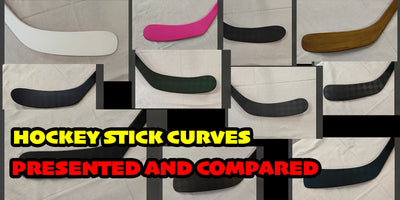
The Datsyuk curve is a balanced mid-curve. If you want to find out which curve suits your game, our big guide helps. Similarly versatile: the P90TM and the models in our Top-5.
Related guides: Leon Draisaitl's stick in detail



 SOYUZ HIT GRIT
 SOYUZ AURORA
 SOYUZ ARCANE