How to Spot Fake Hockey Sticks: Prices, Customs Rules and 9 Signs
The key points
Fake hockey sticks are no longer a fringe issue. In 2025 the Federal Office for Customs and Border Security recorded 11,476 counterfeits in commercial goods traffic in Switzerland – around 38 percent more than the year before, and over 90 percent of them arrived as small postal parcels. For hockey sticks that means one thing in practice: if someone offers you a current top model for CHF 150, look closely. Swiss specialist retailers really do sell run-out models in that price range – but if the offer comes from an unknown online shop abroad, a counterfeit is more likely than a bargain.
And unlike in the EU, the rule in Switzerland is: importing for purely private use is prohibited as well. Customs may hold the shipment back and have it destroyed. For import for personal use alone, a private individual does not commit a criminal offence under Article 65a of the Trade Mark Protection Act – your money and your stick are gone all the same. Anyone who resells or orders in non-private quantities does not fall under this exception.
Contents
- How big the problem really is
- Why the price maths doesn't add up
- Nine signs that give a counterfeit away
- Where the brands put their pro stock codes
- Pro stock is not the same as fake
- What happens when customs intercepts the shipment
- Warranty: why a counterfeit is never covered
- How dangerous are counterfeits really?
- The honest alternative to the brand price
- Common questions
How big the problem really is
According to the joint report by the OECD and the EUIPO, global trade in counterfeits reached a volume of around 467 billion US dollars in 2021. That corresponds to 2.3 percent of all global imports – and for imports into the EU it is as much as 4.7 percent.
For Switzerland there are more precise and more recent figures. The Federal Office for Customs and Border Security (FOCBS) reports the following development for 2025:
| Year | Findings in commercial goods traffic |
|---|---|
| 2021 | 5,959 |
| 2022 | 7,964 |
| 2023 | 7,811 |
| 2024 | 8,318 |
| 2025 | 11,476 |
The figure for 2025 is made up of 5,271 findings by the FOCBS and 6,196 by the Swiss Federal Institute of Intellectual Property. The IPI has been running the procedure for small consignments since 1 July 2025.

Two details in these statistics matter to you as a buyer:
- Over 90 percent of the counterfeits detected at the border are small consignments with up to three items – so not container loads, but individual parcels sent to private addresses. That is what the Federal Council's statement on the new destruction procedure says, and it explicitly blames the growth of online retail for it.
- 86.4 percent of the small consignments objected to in 2025 came from China, another 9.9 percent from Hong Kong. For larger shipments, China accounts for 66.7 percent and Hong Kong for 19.6 percent.
The countertrend in travellers' traffic is interesting: there, findings fell from a peak of 2,880 in 2021 to 1,442 in 2025. So counterfeits are no longer bought on holiday, they are ordered online.
Andrea on the fake market
We also covered the topic on video – here is the short version from practice:
Andrea explains in the video what the fake market looks like from our side of the counter.
Why the price maths doesn't add up
The price is the most reliable warning sign there is – provided you know what a stick actually costs. So here are real list prices from Swiss specialist retail (as of August 2026, senior composite, current top models):
| Brand | Example model | List price |
|---|---|---|
| CCM | Jetspeed FT9 Pro / Ribcor Trigger 10 Pro | CHF 429.– |
| Warrior | Alpha DLUX Pro / Covert DLUX Pro / QR7 Pro | CHF 399.– |
| TRUE | Project X Storm / HZRDUS Smoke | CHF 399.– |
| Bauer | Vapor Flylite / Supreme Fuse | CHF 369.– |
In clearance sales these models come down to roughly CHF 200 to 300. That is the realistic floor for a genuine, new top stick in Switzerland.
One thing to keep in mind: a low price on its own proves nothing. Swiss specialist retailers regularly sell previous-year models for CHF 130 to 150, and those are flawless originals. What matters is the combination – a supposedly current top model priced well below the usual clearance level, offered by a seller who is not an authorised dealer.
The reason genuine sticks cost so much has little to do with greed and a lot to do with materials, tooling costs and marketing budgets. We broke that down in 6 reasons why hockey equipment is expensive and in The truth about expensive hockey sticks.

Nine signs that give a counterfeit away
No single sign proves a counterfeit on its own. But if three or four come together, keep your hands off it.
| Sign | How it looks on the original | What's suspicious |
|---|---|---|
| Price | In line with the list price or a plausible clearance sale | Well below the usual clearance level, with no apparent reason |
| Print and graphics | Sharp edges, even colours, heat-transferred logos | Pixelated edges, bubbling, stickers peeling off |
| Serial number | Cleanly applied, individual to each stick | Missing, handwritten, or identical across several listings |
| Flex details | All details on shaft, label and listing match | Shaft says 85, label says 95 |
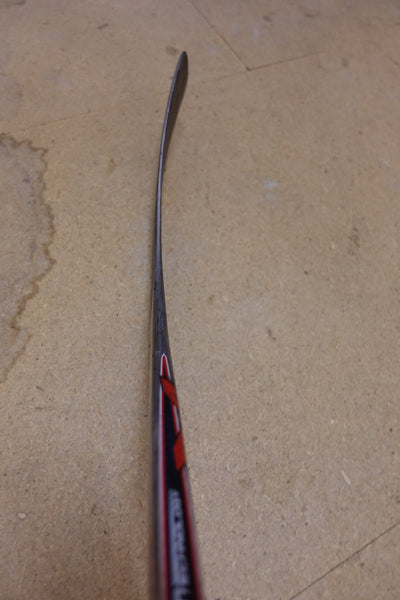
| Blade-to-shaft transition | Seamless, no gaps, no glue residue | Visible seams, excess glue, untidy edges |
| Carbon weave | Even and tight, no air pockets | Irregular pattern, bubbles under the finish |
| Weight and balance | Matches the stated model | Noticeably heavier or more top-heavy than expected |
| Availability | Limited quantity, different flex values | Unlimited identical sticks in the same flex |
| Packaging | Manufacturer packaging with complete details | Generic film with no manufacturer details |
Warning signs on the shop itself
The Swiss platform Stop Piracy, which the FOCBS and the Swiss Federal Institute of Intellectual Property are also part of, lists these characteristics of dubious online shops:
- An unrealistically broad range at consistently very low prices
- Domain names built with elements like "outlet" or "cheap"
- Machine-translated text and obvious spelling mistakes
- Missing or incomplete legal notice without a verifiable address and phone number
- Trust seals that don't link to the issuing body
- Product names like "replica", "imitation" or "lookalike"
Where the brands put their pro stock codes
On pro stock sticks, every brand puts its markings in its own place. If you know where to look, you'll spot a badly made counterfeit in seconds. Important: retail sticks from normal shops carry no player name bar – there, the serial number is what you check.
| Brand | Where the marking sits |
|---|---|
| Bauer | Name bar in the middle of the shaft with player ID, model code and flex – printed or hot-stamped, never handwritten. For warranty cases Bauer also requires the white serial number sticker. |
| CCM | Sticker at the top end of the shaft with model and graphics code, plus a name bar with flex and shaft shape. |
| TRUE | No code on the shaft. The name bar contains the player ID and the flex as a numeric code. |
| Warrior | Details in white lettering on the back of the shaft, right next to the flex figure. |
A sticker that comes off easily or has clearly been stuck over an existing label is one of the clearest warning signs of all.
Pro stock is not the same as fake
This is where most of the confusion starts – and where most honest sellers get wrongly suspected.
Pro stock sticks are genuine. Manufacturers build sticks to individual specifications for pros and top juniors and deliver them in batches of six to twelve to the teams' equipment managers. If a player changes their spec, the rest of the batch becomes surplus and reaches the market through dealers. Such sticks often carry a note saying they are not intended for retail – that doesn't make them illegal.
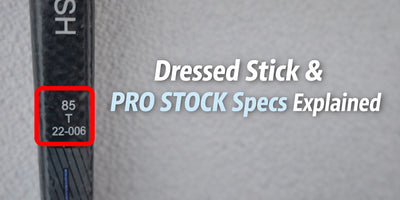
A related term is dressed stick: an older model that a player still prefers and that the manufacturer paints in the look of the current model. New on the outside, the old construction inside. We explained this in detail in Understanding dressed sticks & pro stock specs.
How to tell real pro stocks from fake ones: the name bar of a genuine pro stock carries the name of a specific player who actually ordered that stick. If instead you see a generic combination along the lines of "McDavid P28" – a player's name used as a product name – then that's a retail marketing term and not a pro stock. If something like that is sold as "pro stock" outside specialist retail, be careful.
What happens when customs intercepts the shipment

Here Switzerland has different rules from the EU – a point that gets lost in a lot of guides.
Switzerland has no private use exception
Since 1 July 2008, Article 13 paragraph 2bis of the Trade Mark Protection Act has applied: the trade mark proprietor's claims under Article 13 paragraph 2 letter d also apply where the import, export or transit of commercially manufactured goods takes place for private purposes. So the FOCBS may hold back suspected counterfeits even when you have quite obviously ordered them for yourself alone.
As a private individual you don't commit a criminal offence
Important for context: Article 65a of the Trade Mark Protection Act expressly states that acts under Article 13 paragraph 2bis are not criminal offences. So if you order a counterfeit stick for personal use, you won't face criminal charges. But this exception really only covers personal use: anyone who resells the goods, orders them in non-private quantities or breaches other legislation is not covered. For commercial activity, Articles 61 and 62 of the Trade Mark Protection Act provide for custodial sentences of up to five years.
Since July 2025, destruction is faster
On 1 July 2025 a simplified procedure for small consignments came into force (Article 72i of the Trade Mark Protection Act). It only applies, however, if the trade mark proprietor has requested it. Otherwise the ordinary procedure runs – and there the trade mark proprietor receives your name and address in every case and can claim damages.
How the simplified procedure works:
- The IPI, responsible for small consignments since 1 July 2025, informs you as the orderer in writing that the goods will be destroyed.
- You have ten working days to object explicitly.
- If you don't object, that counts as consent. Destruction takes place at the earliest three months after the notification.
- If you do object, the trade mark proprietor is informed and has to take the case to court.
A small consignment is defined as a shipment with no more than three units and a gross weight under five kilograms – so a single stick falls under it.
In this procedure the costs of destruction are borne by the trade mark proprietor, not by you. Article 72i paragraph 5 also expressly states that the applicant's claims for damages against the orderer are excluded. However, the Swiss consumer magazine Beobachter reported in July 2026 that trade mark lawyers frequently send caught orderers letters with flat-rate damages claims of around CHF 1,000 – and it considers such flat-rate claims legally untenable, because every single franc would have to be substantiated.
The difference from the EU
| Switzerland | EU | |
|---|---|---|
| Online order for personal use | Prohibited, goods can be destroyed | Prohibited, goods can be destroyed |
| Counterfeit in your luggage for personal use | Also prohibited | Exempt under Regulation 608/2013 |
| Definition of small consignment | No more than 3 units and under 5 kg | No more than 3 units or under 2 kg |
| Deadline to object | 10 working days | 10 working days |
So if you're used to Germany, where a souvenir in your suitcase is no problem, you'd be wrong in Switzerland.
Warranty: why a counterfeit is never covered
All the major brands tie their warranty to the same thing: proof of purchase from an authorised dealer.
- Bauer gives 30 days on composite sticks with a one-time replacement and requires the original receipt plus the white serial number sticker. Handwritten receipts and bank statements are not accepted.
- CCM gives 30 days from the date of purchase and only for material or manufacturing defects, likewise against the original receipt.
- TRUE gives 30 days and expressly excludes pro stock products from the warranty.
- Warrior gives 30 days on standard sticks, 60 days on pro sticks and 90 days on SMU models.
A counterfeit meets none of these conditions – if only because it never comes from an authorised dealer. And if the shipment is destroyed by customs, getting your money back is difficult too: the seller is usually based abroad, and reselling or returning the counterfeit would itself be problematic again.
When you buy from Swiss specialist retail, the statutory warranty comes on top of the manufacturer's warranty: under Article 210 of the Swiss Code of Obligations, claims for defects lapse two years after delivery, and for purchases for private use this period may not be shortened by contract. Article 201 of the Swiss Code of Obligations matters here too – you have to report a defect immediately after discovering it, otherwise the item counts as accepted.
How dangerous are counterfeits really?
At this point we're deliberately more cautious than most articles on the subject.
We found no solid studies, recalls or documented injury cases specifically relating to counterfeit hockey sticks. Anyone claiming that counterfeit sticks demonstrably cause injuries generally can't back it up.
What can be said:
- Counterfeits go through no documented testing and quality processes. There is no batch testing, no material approval, no traceability.
- The OECD explicitly links counterfeit trade in general to risks for consumer safety, and the EUIPO writes about counterfeit sporting goods that they carry considerable health risks because safety and environmental standards are not met.
- A carbon stick that breaks under load leaves sharp fibre bundles behind. That's just as true of a genuine stick – except with an original you know what breaking load was designed in.
Honestly, the bigger and safer argument isn't safety, it's money: you're paying for a product whose properties nobody guarantees, and in the worst case you end up with neither the stick nor a refund.

The honest alternative to the brand price
The reason anyone reaches for a counterfeit in the first place is understandable: CHF 400 for a stick that lasts one season is simply too much for many players, and all the more so for families with two kids in a club.
It's just that the counterfeit is the wrong answer to a valid problem. The alternative isn't to copy a brand cheaply, it's to leave the brand out.
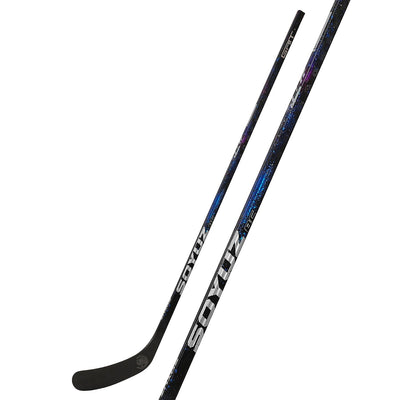
That's exactly what we do. Our sticks run under our own name, in comparable carbon construction, but without marketing budgets and pro contracts that we don't have to help finance. You know who builds them, you get a proper receipt, and you can set flex, curve, length and grip yourself.
How that works is described in Ordering a custom hockey stick. If you want to compare first, our Hockey stick buyer's guide puts all the brands side by side – and ABSHockey vs. Bauer, Warrior, CCM has the direct price comparison. More about the brand itself: About SOYUZ.
Common questions about counterfeit hockey sticks
Is it a criminal offence to order a counterfeit hockey stick?
Not for import for purely personal use: Article 65a of the Trade Mark Protection Act expressly exempts acts under Article 13 paragraph 2bis from criminal liability. But this exception only covers personal use. The import is prohibited nonetheless – customs may hold the goods back and have them destroyed. Anyone importing or reselling counterfeits commercially, on the other hand, risks up to five years' custodial sentence.
What actually happens if my parcel gets stuck at customs?
You're notified and have ten working days to object. Without an objection, that counts as consent to destruction, which takes place at the earliest three months later. In the simplified procedure the costs of destruction are borne by the trade mark proprietor.
Do I get my money back if customs destroys the shipment?
Not from customs. A refund claim is only possible against the seller, and they're usually based abroad, which makes enforcement practically hopeless.
What's the quickest way to spot a counterfeit?
By the serial number and by the combination of price and seller. A supposedly current top model far below the usual clearance level, sold by a seller with no verifiable address, is suspicious. And if the same serial number turns up in several listings, is handwritten or is missing entirely, you don't need to look any further.
Are pro stock sticks counterfeits?
No. Pro stock sticks are genuine manufacturer products, built for pros and not intended for retail. Their name bar carries the name of a specific player. Be careful if a stick is sold as "pro stock" but only carries a generic model name with a player's name on it.
What does a genuine top stick cost in Switzerland?
Current top models are around CHF 369 to 429 list price in specialist retail. In clearance sales CHF 200 to 300 is realistic, and previous-year models come down to CHF 130 to 150 as well. As of August 2026.
Does a warranty apply if I order from abroad?
Only if the dealer is authorised. All the major brands require the original receipt from an authorised dealer for warranty cases, and Bauer also requires the white serial number sticker. Without that there's no claim.
Can I bring a counterfeit back from holiday?
Not into Switzerland. Unlike EU Regulation 608/2013, which exempts goods of a non-commercial nature in personal luggage, Swiss law doesn't have this exception. Findings in travellers' traffic have been declining for years, though.
Do counterfeit sticks break sooner?
That's often claimed, but it isn't backed up by studies. What is verifiable is that counterfeits go through no documented quality assurance and that there's no traceability whatsoever. That's reason enough for caution, even without dramatic claims.
How do I recognise a dubious online shop?
By an unrealistically broad range at rock-bottom prices, by a missing or incomplete legal notice, by machine-translated text and by trust seals that don't link to any issuing body. The federal Stop Piracy portal lists these characteristics in detail.
Conclusion
The counterfeit market is growing, and the Swiss customs figures show it clearly. For you as a player that mainly means one thing: the price alone isn't an indicator of a bargain, it's the first warning sign.
Check the serial number, look at the transition from blade to shaft, compare the flex details – and buy from someone you can reach if there's a problem. Whether that's us or another specialist dealer is secondary. What matters is that there's someone at the other end who stands behind the stick.
This article reflects the situation as of August 2026 and is for general information. It does not replace legal advice. In a specific case, contact the FOCBS or a specialist.


 SOYUZ HIT GRIT
 SOYUZ AURORA
 SOYUZ ARCANE