Ice Hockey Stick Size Chart: by Height, Weight and Age
Ice hockey stick size: the chart by height, weight and age
This page is meant for looking things up. You find your row, note down category, length and flex – and you are done in half a minute. The explanations follow further below, in case you want to know why the values look the way they do.
One note up front that prevents most bad buys: for the length what counts is your height, for the flex your weight. Not your age. Age is in the chart only as a rough guide, because kids born in the same year can be up to 25 cm apart.
The reference chart
| Height | Weight | Category | Flex | Stick length | Age (approx.) |
|---|---|---|---|---|---|
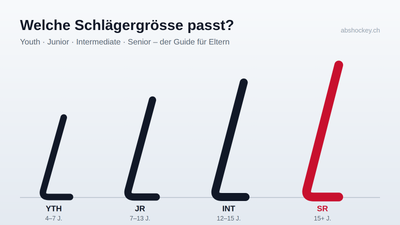
| up to 125 cm | up to 25 kg | Youth (YTH) | 20 | 43–47″ · 110–120 cm | 4–7 |
| 125–140 cm | 25–35 kg | Youth (YTH) | 30 | 47–52″ · 120–132 cm | 6–9 |
| 140–152 cm | 35–45 kg | Junior (JR) | 40 | 52–56″ · 132–142 cm | 8–11 |
| 152–162 cm | 45–55 kg | Junior (JR) | 50 | 56–59″ · 142–150 cm | 10–13 |
| 158–168 cm | 55–62 kg | Intermediate (INT) | 55 | 58–61″ · 148–156 cm | 12–15 |
| 165–175 cm | 62–70 kg | Intermediate (INT) | 60–65 | 60–63″ · 152–160 cm | 14–17 |
| 170–180 cm | 70–80 kg | Senior (SR) | 70–75 | 61–65″ · 155–165 cm | 16+ |
| 176–186 cm | 80–90 kg | Senior (SR) | 80–85 | 63–67″ · 160–170 cm | 16+ |
| 182–192 cm | 90–100 kg | Senior (SR) | 90–95 | 65–69″ · 165–175 cm | 16+ |
| 190 cm and up | over 100 kg | Senior (SR) | 100–105 | 67–71″ · 170–180 cm | 16+ |
The categories overlap on purpose. If you fall between two rows, your height decides the category and your weight decides the flex – the two do not have to come from the same row. A player 168 cm tall weighing 75 kg takes a Senior stick at 61–62″ with Flex 75.
Flex: your weight in kilograms
The simplest rule that works for us: body weight in kilograms ≈ Flex. If you weigh 78 kg, you start at Flex 75 or 80. If you weigh 62 kg, at 60 or 65.
You will come across the American version online – half your body weight in pounds. At 78 kg that lands on Flex 85 and turns out too stiff for the vast majority of amateur players. A stick that is too stiff simply does not load up on the shot; you notice it because the puck does not go anywhere even though you are giving it everything.
Two adjustments to this starting value:
| If you … | Adjustment | Why |
|---|---|---|
| work with the puck a lot, play wrist shots, are a forward | one step softer | The stick loads up faster, the release gets shorter |
| are a defenseman and often shoot from the blue line | one step stiffer | On the slap shot more force goes into the shaft, a soft stick loses precision |
| are just starting out | one step softer | Technique develops faster when the stick works with you |
One step is 5 points for us. You should not deviate by more than one step – otherwise the basis no longer holds.
Which Flex values actually exist per category
Many charts online recommend values that nobody makes. Flex 45, for example, does not exist. This is our real grid:
| Category | Flex values | Shaft width |
|---|---|---|
| Youth (YTH) | 20, 30 | very narrow, very light |
| Junior (JR) | 40, 50 | narrow |
| Intermediate (INT) | 55, 60, 65 | just under Senior |
| Senior (SR) | 65 to 105, in 5-point steps | Standard |
The shaft width is the reason categories exist in the first place. A Junior shaft is not only shorter and softer, it is also thinner – otherwise a child cannot get a proper hand around the shaft at all. The other way round, a Junior shaft feels lost in an adult hand, even if length and flex would add up on paper.
How you measure the length
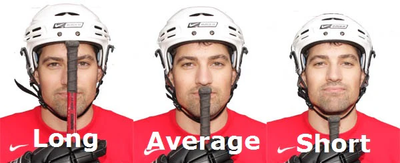
Stand up in trainers, stick upright next to you, blade tip on the floor. The top end of the shaft should sit between chin and nose.
- Closer to the chin – more control in puck handling, a better position at face-offs, a lower stance.
- Closer to the nose – more reach and more leverage on the slap shot. Typical for defensemen.
On skates everything shifts up by about 5 cm: there the stick should reach roughly to your chin. Both rules describe the same length, just once with and once without runners.
Stick length by height
If you want it more precise than the category chart above – here in 5 cm steps. "Chin" is the short, control-oriented option, "nose" the long one:
| Height | to chin (short) | to nose (long) |
|---|---|---|
| 130 cm | 113 cm · 44″ | 120 cm · 47″ |
| 140 cm | 122 cm · 48″ | 129 cm · 51″ |
| 150 cm | 130 cm · 51″ | 138 cm · 54″ |
| 155 cm | 135 cm · 53″ | 143 cm · 56″ |
| 160 cm | 139 cm · 55″ | 147 cm · 58″ |
| 165 cm | 144 cm · 57″ | 152 cm · 60″ |
| 170 cm | 148 cm · 58″ | 156 cm · 61″ |
| 175 cm | 152 cm · 60″ | 161 cm · 63″ |
| 180 cm | 157 cm · 62″ | 166 cm · 65″ |
| 185 cm | 161 cm · 63″ | 170 cm · 67″ |
| 190 cm | 165 cm · 65″ | 175 cm · 69″ |
| 195 cm | 170 cm · 67″ | 179 cm · 70″ |
Careful: there are two ways of measuring
This is the point where online buying goes wrong most often. Two manufacturers can list the same stick as "63 inches" and as "58 inches", and both are right:
| Way of measuring | What is measured | Difference |
|---|---|---|
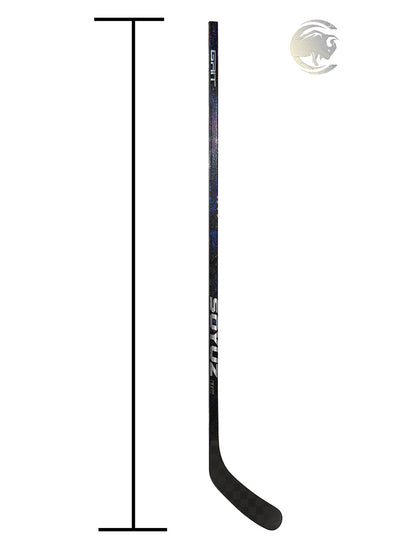
| Total length | Blade tip on the floor up to the top end of the shaft | Reference |
| Shaft length | the shaft only, without the blade | around 12–13 cm or 5″ shorter |
All figures on this page are total lengths – the way you can measure them against your chin at home. If you come across a number somewhere that is around 5 inches smaller than expected, it almost certainly refers to the shaft length. Ask if in doubt; that is a two-line email and it saves you an unusable stick.
What cutting down and extending do to the flex
The length can be adjusted, but not without consequences. A stick that has been cut down gets stiffer, an extended one softer:
| Change | Effect | Rule of thumb |
|---|---|---|
| Cutting down | Stick gets stiffer | around 2–3 flex points per 2.5 cm |
| Extending | Stick gets softer | around 2–3 flex points per 2.5 cm |
An example: you order Flex 75 and cut off 5 cm. Effectively you are then playing about an 80. If you know you are going to cut it down, order the flex one step softer right away. How that works in practice is in the guide to cutting down and extending.
Kids: the three most common mistakes
- Buying it too long so it fits for longer. A stick that is too long forces the child into an upright posture, puck handling drifts out in front of the body and the flex gets softer on top of that – a 40 that is too long plays like a 30. Better to buy the right size and get a new one after the season.
- Going by age instead of height. Two ten-year-olds can be 135 and 158 cm tall. The category follows height, never the year of birth.
- Forgetting the flex. For adults a slightly wrong flex is a matter of taste, for kids it is not. A 35 kg child cannot bend a 70 shaft and therefore never learns to load the stick.
More on that in the parents' guide to kids' ice hockey sticks.
What you have now – and what is still missing
Category, length and flex are the three numbers that decide the fit. Two decisions are still missing, and those are taste, not measurement: the blade and the kick point. If you are unsure about both, take P92 or P28 with a mid kick point – that way you will never be far off.
You can put it all together in the configurator: size, flex, length, blade and grip in one go. If you would rather ask someone, write to us – we will work it out for you before you order.
Further guides
- Choosing the right flex – the long version on the topic of flex
- The right length for your stick
- Left- or right-handed? – the question that comes before all others
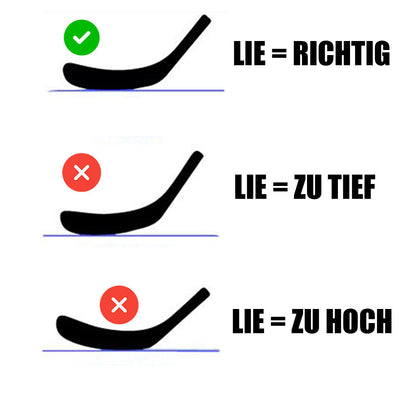
- Lie 4, 5, 6 – what the angle does
- Stick Finder – four questions, one model suggestion