Miro Aaltonen's Stick: A Blade With No Code – and What That Tells You
Miro Aaltonen's Stick: A Blade With No Code – and What That Tells You

On most pro stock sticks, half the configuration is printed on the shaft: flex, curve code, player number, factory code. On Miro Aaltonen's Bauer, the one thing players care about most is missing – the blade.
We were allowed to photograph the stick at a collector's. What's printed on it, what isn't, and why the missing part is the more interesting story.
What's on the Shaft
- Model: Bauer Vapor Hyperlite
- Flex: 77
- Shot: Left
- Player ID: 159107-0
- Curve: no code
- Grip: Red grip tape, overlapping up to the butt end
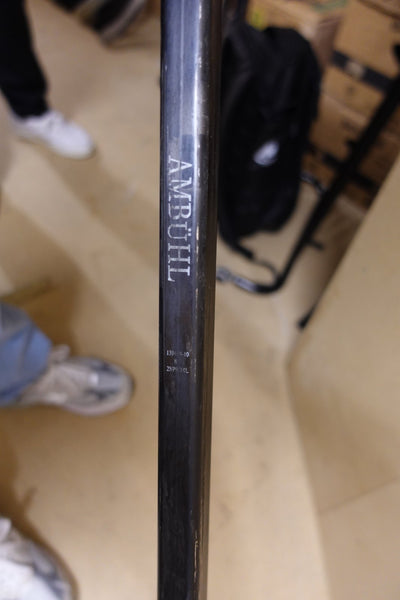
The number 159107-0 is not a serial number but Aaltonen's player ID at Bauer. The factory uses it to assign every single stick to the right pro – length, flex, blade and paint job all hang off that one number. We saw the same system on Trevor Zegras (171941-2) and on Andres Ambühl's stick.
The fact that it reads HYPERLITE and not HYPERLITE 2 places this stick in the first generation. Bauer adds the numeral from the successor onwards.
The Flex: 77 for a Centre
77 is a moderate figure – and it puts Aaltonen in a pattern we keep running into across this series. Patrick Kane plays 77, Zegras the same, Malkin 87.
The idea that pros play especially stiff sticks is persistent – and in this form it isn't true. If you want a quick release, you'd rather load the shaft easily than heavily. The exception in our series so far is Leon Draisaitl at 100 – and he scores through power, not speed.
The Blade: What You Can See Without a Code

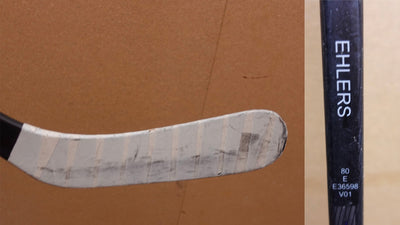
There is nothing written on the blade. No PRO code, no number, nothing. So all we can do is describe what's visible:
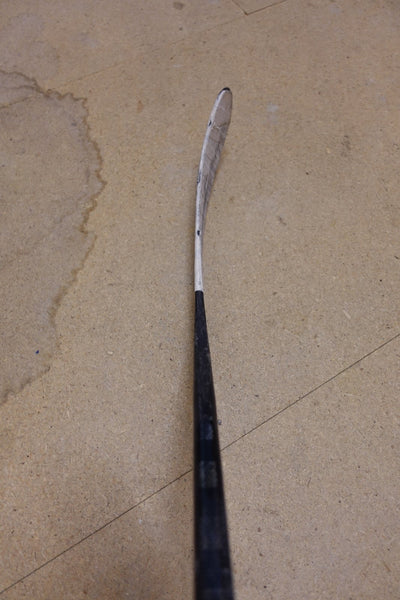
The curvature starts mid-blade and runs evenly out to the tip from there. No step at the heel, no abrupt kick at the front. The toe is round, the face open.
Why Is There No Code?
This is the second stick in the series without a blade code – after Andres Ambühl's. And the explanation is the same in both cases, even if it works out differently.
Retail codes like P92 or P88 exist so you know what you're buying in a shop. A pro doesn't buy in a shop. His blade is built against a stored specification – the player ID on the shaft is the code. Anything more would be redundant.
With Ambühl the code was missing because his shape is so specific that no retail equivalent exists. With Aaltonen it is likely the reverse: the shape sits so close to a standard blade that there is nothing to name. Both lead to the same blank blade.
An Untaped Blade – and What It Reveals

The blade is bare – no tape, just carbon, plus Aaltonen's signature and his 15.
Honestly: we don't know whether this stick ever saw the ice. Either it was never played, or the tape was removed for the signature. Both are plausible, and we didn't see it in the state it left the dressing room in. Unlike Nico Hischier or Zegras, where we could show the original tape job, we can say nothing about how this one was played.
What it does give us is something you rarely get to see: the bare blade shape, without tape softening every edge.
The Red Grip

The butt end carries red grip tape, wrapped in clean overlapping turns with a compact finish at the top. No built-up knob, no spiral.
Coloured grip tape is more common among pros than you'd think – Zegras plays yellow. Nobody sees it on the ice, but in the dressing room you find your stick in a split second. With a dozen identical black sticks in the rack, that's the actual point.
The Player
Miro Aaltonen, born 1993, is a Finnish centre and has been under contract with SC Bern since 2025. Before that he spent three seasons with EHC Kloten. His biggest achievement: Olympic gold in 2022 with Finland.
A centre with a 77 flex and an open mid curve – that fits a player who works through quick releases and puck control rather than a hard shot from distance.
Not sure which curve fits your game? Take our 2-minute stick finder and find your model.


 SOYUZ HIT GRIT
 SOYUZ AURORA
 SOYUZ ARCANE